Showing posts with label ecommerce news. Show all posts

Tuesday, June 16, 2015

5 Personalization Tips to Grow Your Ecommerce Business

We all know that personalization and customization can go a long way toward building a relationship with potential buyers. The thing is, personalization is so much more than just greeting the customer by name when they visit your website. That’s a great first step, but it’s not the only benefit you can get out of gathering information about your customers. Want to know what else you can do? Here are some tips.


Offer Custom Content

No matter what you sell on your ecommerce site, we’re sure that you haven’t shared all the possible information about every single product. The things you can’t fit on your website don’t have to languish forever. Instead, create helpful guides, ebooks, white papers, case studies, checklists, how-to instructions, tutorials, and anything else you can think of to get that information into the hands of your buyers.

When you have information that buyers are searching for specific products, offer them the applicable content to help them make up their minds. After they make a purchase, provide them with the tutorials and instructions they need to make the most of their products.

Sell scarves? Offer an ebook with ten different ways to wear that new scarf. Sell lawnmowers? Give a spec sheet that compares the various mowers each customer researches. There really will be something for everyone at any point in the buying journey.

Move Buyers Through the Journey

Speaking of the buyer's journey, personalization helps you guide those buyers through every point from awareness to delight. The ultimate faux pas after meeting someone is to introduce yourself again the next time you see him or her as if you’ve never met before. If only you had some way to remember who you’d met before, how many times you’d met, how interested they were in what you had to offer, and how close they were to making a purchase.

With personalization options on your ecommerce website, you can track each and every customer through every step of the buying process. You’ll know when to start greeting them by name, when to send them more information about the products that interest them, and which products to recommend. 

Provide Better Product Recommendations

Oh, the product recommendations! Most ecommerce businesses attempt upselling and cross-selling with product recommendations. What are those recommendations usually based on? In many cases, they’re based on what previous buyers purchased. Since not every buyer is created equally—and sometimes people just buy really weird stuff—the recommendations aren’t always relevant.

By using the information you gather on each and every buyer, you can craft much more relevant recommendations. For instance, if someone is searching for lawnmowers, you could show them various mowers with similar specs. It wouldn’t be way off base to show them a weed trimmer, either. If, however, you threw in a patio table umbrella just because the last person who bought a mower also bought an umbrella, you’d only succeed in confusing your current customer.

Improve Segmentation

Because consumers aren’t all created alike, you’ll need to work hard and often on segmenting your buyers according the wants, wishes, tastes, income, and any other descriptor you can think of. Absolutely every segmentation you can think of will apply.

For instance, Molly and Sue may both be female, between age thirty and thirty-five, and have roughly the same income. Does that mean they’re always lumped together? Of course not. Molly is married with kids and lives in the Midwest. Sue is single and ready to mingle and living in Manhattan. The amount of income they have to spend on online purchases, the types of items they’ll buy, the weather where they live—all of these things are different, and they’ll affect the marketing messages they react to.

Use Segmentation to Your Benefit 

When you can segment your buyers with every bit of information you know about them, you have the ability to use that information at any given time. For instance, what if you had a pop-up message for all buyers experiencing sunny weather offering a discount on your best sunscreen moisturizers just for that day? Those who have rain and humidity would probably appreciate a frizz-control hair product ad instead.

You can use segmenting a million different ways, and all of those ways will help you build strong relationships with loyal customers. It’s yet another way you can surprise and delight consumers so they stick around for more and bigger purchases.




Friday, May 15, 2015

Govt discusses FDI in e-commerce with Flipkart, Snapdeal, Amazon and industry stakeholders

With the government holding discussions on FDI in e-commerce with various stakeholders, industry today said there should be a parity between online and offline retail policy, reports PTI. The government discussed various issues related with foreign direct investment in e-commerce sector with several stakeholders including Flipkart, Snapdeal, Amazon and industry associations like CII, FICCI, NASSCOM etc.


According to PTI, at present, 100 per cent Foreign Direct Investment (FDI) is allowed only in business-to-business (B2B) e-commerce and not in retail segment.

“FICCI feels that FDI should be allowed in B2C e-commerce with a focus on sourcing from manufacturers and in a phased manner. The idea is to emphasize that there has to be a parity between online and offline retail policy with respect to FDI levels,” the chamber said.

“By broadening the scope of foreign investments in e-commerce to include inventory apart from marketplace, the government would be placing the Indian industry at par with other emerging markets where both marketplace and inventory models are able to operate freely. As the policy is reviewed, it is important to focus on development and encouragement of MSME sector which is certainly the driving force behind the vision of Make in India. This should ensure domestic manufacturing gets impetus,” FICCI stated.

However, CII said that e-commerce in India is at a relatively nascent stage and the market is yet to attain full maturity level. “While CII is favourably inclined towards 100 per cent FDI in B2C route, the sector should be given some time to come to a level where it can compete globally,” it said.

NASSCOM President R Chandrashekhar said growth of e-commerce is essential because it would enhance efficiency and access to market for small manufacturers and people in the unorganised sectors. “Nurturing of the e-commerce players through investment, including FDI is a very important development. A view expressed by some that e-commerce could lead to greater imports. We do not hold that view at all,” he said.

FICCI said that FDI in e-commerce would create new global markets for small businesses and help them scale at almost no cost besides generate employment and spur investment in supply chain management, warehousing and logistics services.

CII too said that it favours 100 per cent FDI in B2C route and the sector should be given some time to come to a level where it can compete globally. It recommended that the policy should establish a level playing field for all stakeholders in the e-commerce sector besides ensuring safeguards to Indian players such as mandatory local sourcing, privacy, safety against tax evasion, checking e-wastage. It took the line that retail business should not be classified based on channels like offline stores and online.

CAIT said that instead of allowing FDI in e-commerce, a study should be made about the advantages to the nation accrued so far from allowing 100 per cent FDI in single brand retail and 51 per cent in multi-brand retail. “A Board of Internal Trade should be constituted giving participation to domestic trade representatives to regulate and monitor the internal trade of India and to make it compatible to meet global challenges. Specific act, laws, rules must be formulated for conducting domestic e-commerce business,” it added.

In a statement, NASSCOM said that the FDI policy should address diverse needs of entrepreneurs and investors. “It is imperative that entrepreneurs, who have already made significant investments and are looking ahead to a robust growth and market share, should be allowed to seek investments to support business operations. The government should work towards creating conditions that motivates e-commerce start-ups and investors, and not bog them down with regulatory conditions and unviable restrictions,” it added. It also said that there should be no mandate to conclude sale of products sourced from India.

“The policy should stipulate that companies should offer 30 per cent locally sourced products, without any criteria related to sourcing from SMEs,” NASSCOM added. Further it said any restrictions imposed by states will serve to deprive the sector from the inherently efficient processes and infrastructure development opportunities, contributing to employment and revenue generation opportunities.

“E-commerce has seen funding to the tune of USD 3 billion and is growing tremendously. It is also attracting global interest as is evident from SoftBank’s investment of USD 10 billion in India over the next few years,” NASSCOM said. It has emphasised that “100 per cent FDI should be allowed in B2C ecommerce and there should not be any conditions and stipulation on investment in back end infrastructure.”

It informed the meeting that the e-commerce companies are facing numerous regulatory challenges in different states. It asked the government to publish broad guidelines that enable ease of doing business for these companies and could be adopted by the state governments. At present, the industry accounts for revenue of USD 14 billion growing at CAGR of 25 per cent since FY’2010, it added.

e-commerce

Our successful eCommerce software solutions deliver an optional shopping experience for targeted prospects. Our solution creates fast, easy browsing and simple ordering and checkout process.Pixotri technology is a  creative house developing quality web designs, E-Commerce solution. SEO services and Gaming development .

Contact us for your online shopping requirements email-info@pixotritechnologies.com. Visit our website: www.pixotritechnologies.com

Monday, May 11, 2015

How e-commerce can help traditional workers

I was recently in Geneva to attend a meeting that discussed the experience of growing e-commerce in developing countries. The meeting was organized by Friedrich-Ebert-Stiftung (FES) Geneva, a non-profit organization that works in the areas of trade, development and human rights.


There were representatives from countries such as Cuba, the Dominican Republic, El Salvador, Panama, Guatemala, Peru, Mauritius, Trinidad and Tobago, Costa Rica, Ecuador and Venezuela. The World Trade Organization (WTO) and the United Nations Conference on Trade and Development (Unctad), too, sent their representatives. Among the concerns raised at the conference was the gradual shift of trade in developing countries to online channels—areas in which these countries lag.

I am no expert on e-commerce and cannot speak on its legislative, regulatory or policy aspects. Yet, I guess the reason they invited me was not just to know about e-commerce issues in developing countries, but also to know how connectivity, access, digital literacy and mobile penetration could help expand e-commerce activities.

The nations mentioned above need to lobby the WTO so their businesses, too, can benefit from this shift.
Ironically, similar discussions on how technology-driven e-commerce can help small town communities and micro-business clusters based on traditional skills are conspicuously absent in India. It was, therefore, heartening to note there are Latin American countries that are concerned for the right reasons.

Unctad has published a report called Information Economy Report 2015: Unlocking the Potential of E-commerce for Developing Countries, in which India finds mention only in a few places. “It is not that not much is happening in India in the e-commerce sector, but it is so hard to get good data from India, and that’s one reason we don’t have much of India in the report,” Unctad representative Torbjörn Fredriksson told me.

At the meeting, I shared a homegrown model on how a connected micro-enterprise cluster can be nurtured into a digitally enabled cluster, and how such connected and broadband-enabled traditional skills-based clusters could change the entire business ecosystem, with e-commerce perched like a crown at the top.

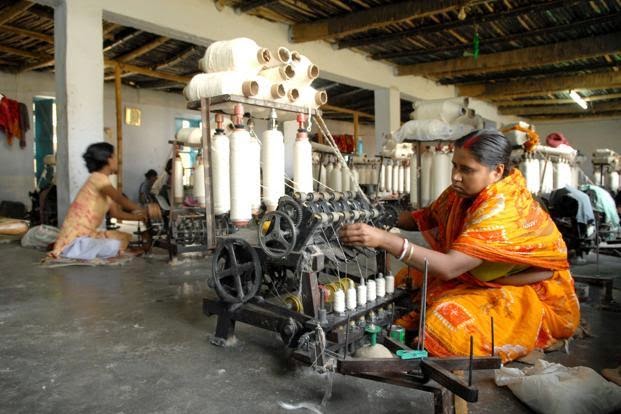
Chanderi is a cluster of about 3,500 weaving households in Madhya Pradesh that has been involved in weaving fine silk fabrics, including saris, for several centuries. It is just one of India’s estimated 545 traditional handloom weaving clusters and 2,000 traditional skills-based clusters.

These clusters suffer from apathy, exploitation by middlemen, poor market reach, bad health and education facilities, lack of alternative livelihood, poor civic amenities, broken government infrastructure and unfulfilled promises. However, all such clusters have one thing in common: they are populated by enterprising people who understand the meaning of profit and loss.

When I shared with our Latin American friends and Unctad how the fortunes of Chanderi changed in three to five years, they told me that they wanted to replicate the experience in their countries. I pointed out that the major change came from widespread connectivity, availability of Wi-Fi on demand, and connecting schools, shops, banks, offices, post offices, health centres and all those micro-enterprises to the Internet. Today, there is a dedicated centre where all silk fabric designs take place digitally and on machines by the weavers themselves, rather than on sheets of paper. Even big businesses and traders get their designs done from this digital design centre by paying a fee.

Products featuring mesmerizing weaving designs are available at chanderiyaan.net, an e-commerce portal. However, the real story is that most of the logistics related to photographing products, uploading them online, managing customers and couriering goods are all done by members of the local community with little outside intervention. According to a study by the Indian Institute of Technology, Kharagpur, Chanderi’s turnover from the weaving cluster has tripled simply by removing the information asymmetry.

The clear message is that each and every cluster in the country that can be classically defined as a traditional skill-based cluster could adopt a holistic approach to meticulously integrating digital tools and connectivity in each segment of the ecosystem and enjoy the story of a sustainable economic and cultural transformation.

While I hope that the Chanderiyaan model could be replicated across all weaving clusters of the country and perhaps several Latin American countries, too, we at the Digital Empowerment Foundation have our task cut out to replicate the model in at least three more clusters. Work has now started at Barabanki in Uttar Pradesh and Bargarh and Nuapatna in Odisha.

Digital marketing

Digital marketing helps you to find yourself in first place among the other competitors. We help you to strategically plan and execute your,product and services through our online platforms.Pixotri technology is a  creative house developing quality web designs, E-Commerce solution. SEO services and Gaming development .

Contact us for your Digital marketing requirements .email-info@pixotritechnologies.com. Visit our website: www.pixotritechnologies.com

ChannelSight signs ecommerce technology deal with Mondelez

Irish technology firm ChannelSight has signed a partnership with Mondelez International that will see the multinational company use its ecommerce technology to drive sales.


ChannelSight allows brands to add “buy it now” buttons to its product pages, social media video advertising and other online campaigns, linking to retailers that stock the products.

“What’s cutting edge is what we’ve developed for after the customer clicks the buy-it-now button,” said ChannelSight chief executive John Beckett. Customers are presented with a list of relevant retailers that stock the product. This list is compiled through ChannelSight’s technology rather than partnerships struck with the retailers.

“It’s not reliant on feeds from the retailer,” he said.

The company has developed technology that crawls retailers’ sites, and even if they are using different information or a slightly different image from the brand’s official one, it will recognise the product and add it to the list.

Mr Beckett said conversion rates from advertisements can increase, while the retailer can also gain valuable data such as what ads drive the most interest and lead to sales.

Mondelez, which owns brands such as Cadbury and Oreo, has already piloted the technology in 20 markets with more than 100 retailers, and now plans to add the buy-it-now buttons to media platforms across 25 markets, linking to more than 130 retailers’ websites.

“As a global company, we’re looking at converting all our media investments into buying opportunities for consumers by driving ecommerce transactions at key retailers’ websites. This partnership is a crucial step . . . to help accelerate growth through ecommerce,” said Bonin Bough, chief media and ecommerce officer at Mondelez International. “By turning more of our branded content into buying opportunities for consumers, we’ll also continue to improve our return on investment and this will help fuel growth for our power brands.”

ChannelSight was established by Mr Beckett and chief technology officer Kieron Dundon in 2013 and has offices in Ireland, Greece and Romania. The company’s account management team is based in Dublin, with its development team in Romania. Mr Beckett said this was primarily due to the availability of the talent needed to develop its products.

It is in the process of raising €3 million in funding, which will fund expansion. “We expect to extend our growth next year,” Mr Beckett said.

Despite the lack of a sales and marketing team, it has already worked with major brands such as Philips, Bosch-Siemens and P&G.

e-commerce

Our successful eCommerce software solutions deliver an optional shopping experience for targeted prospects. Our solution creates fast, easy browsing and simple ordering and checkout process.Pixotri technology is a  creative house developing quality web designs, E-Commerce solution. SEO services and Gaming development .

Contact us for your online shopping requirements email-info@pixotritechnologies.com. Visit our website: www.pixotritechnologies.com