Showing posts with label ecommerce website. Show all posts

Thursday, May 14, 2015

FDI in e-commerce: It’s Flipkart, Snapdeal vs Amazon, eBay

NEW DELHI: The government on Thursday began consultations on FDI in B2C e-commerce amid a sharp divide between Indian and foreign players. While domestic companies such as Flipkart and Snapdeal opposed FDI during a meeting by commerce and industry minister Nirmala Sitharaman, foreign players such as Amazon and eBay made a strong case for it. 


"We have always maintained that opening up this sector to FDI will be good for consumers and Indian businesses as it will allow us to partner with local manufacturers to source products not carried by other sellers on the marketplace, and support the Make in India vision," said an Amazon India spokesperson. 

Around 60 players from the industry, including representatives of Amazon India, Snapdeal, Ikea, Japan Plus, eBay and Flipkart attended the meet. 

Domestic e-tailing companies fear it will allow global giants such as Amazon to bring its inventory-based model here, which works on the principle of buying goods in bulk at a low price from small businesses and selling them at a discount to consumers. Currently, e-tailers operate through a marketplace model where independent sellers use their websites to reach out to customers. 

"FDI in e-commerce will not have a good impact on the Make in India model. It will allow Amazon to squeeze and manipulate small businesses and flood the market with Chinese goods. The e-commerce industry has already received around $9 billion FDI. It has created thousands of jobs. What is the point of changing the policy now," said an executive with a large Indian e-tailing company. 

At present, 100% FDI is allowed in B2B e-commerce space, which helps global retailers such as Walmart operate cash-and-carry business. A Snapdeal spokesperson said, "The government must tread this issue with caution to ensure that there is no adverse impact on the growth of MSMEs in the country." 

A CII spokesperson said, "E-commerce in India is at relatively nascent stage and the market is yet to attain full maturity level. While CII is favourably inclined towards 100% FDI in B2C route, the sector should be given some time to come to a level where it can compete globally." 

Flipkart also flagged tax issues at the meeting, where Sitharaman said it was only the first in a series of consultations and it will take more such meetings to come to a conclusion about FDI in B2C e-commerce.

e-commerce

Our successful eCommerce software solutions deliver an optional shopping experience for targeted prospects. Our solution creates fast, easy browsing and simple ordering and checkout process.Pixotri technology is a  creative house developing quality web designs, E-Commerce solution. SEO services and Gaming development .

Contact us for your online shopping requirements email-info@pixotritechnologies.com. Visit our website: www.pixotritechnologies.com

3 More Tips for Better Ecommerce Video Results


A good ecommerce product video can help online shoppers learn more about a particular item, make an emotional connection to some products, and, ultimately, make a good buying decision.

The premise for this success is relatively simple. Videos can convey more and better product information than text alone. In fact, ReelSEO, an online publication for video marketing, reported that nearly three quarters of online shoppers believe that video content had influenced a buying decision. Given the potential impact, it can make a lot of sense to try to optimize ecommerce video to boost sales.

Back in August 2014, I described three tips for making ecommerce videos more effective.

In this article, you’ll find three more tips or suggestions for making the most out of your product videos. These more recent tips are based on a report from Google, which was largely aimed at video advertising but may offer insights about how to get even better results with videos placed on an online store’s product detail pages.

1. Use a Large Video Player

The Google report, “Are Your Video Ads Making an Impression?,” looked at an approved Interactive Advertising Bureau advertising measurement called a “viewable video impression.” This measurement considers a video ad to be viewable when half of its pixels are visible on the screen for at least two consecutive seconds.

Google wanted to understand what made a video ad more viewable, using this definition. For an ecommerce product video, one would hope that customers would be looking at more than half of the available pixels for a mere two seconds. Nonetheless, the things that make an online video ad viewable might also apply to videos more generally.

For example, Google found that, in general, folks were more likely to watch video ads that played on relatively larger video players.


Of the video players measured, sizes that were larger than 640 pixels by 480 pixels had video viewability rates of better than 80 percent. As an example, players that were 848 pixels wide by 477 pixels high had a video viewability rate of 88.6 percent.

Conversely, the most common player size for video ads — 300 pixels by 250 pixels — produced the lowest video viewability rate at just 19.8 percent.

For video ads, this data is telling, especially since Google drew its data from a sample of video ads shown on a variety of sites and devices.

Assuming that there are at least some similarities between what makes an online video ad viewable and what encourages online shoppers to watch an ecommerce video, consider giving product videos more on-page space.


Online fashion store ASOS uses this approach. Many of the store’s product detail pages include a “View Catwalk” link that opens a relatively large video player.

2. Place Your Video Front and Center

Google also found that video player placement impacted video ad viewability. Videos placed at the center of the screen and within 250 pixels of the top of the page enjoyed the highest video viewability rates.

Again, assuming that the principles that make a video ad viewable are similar to what makes an ecommerce product video get attention, it might make sense to place video players in a prime position on product detail pages.

For online sellers, one good way to manage video position may be to share space with the main product image.


Online kitchen supply retailer Williams-Sonoma includes its ecommerce product videos as a link just below the main product image. When a shopper clicks on the link, the video replaces the main image. While this is probably not as effective as having the video player loaded (full-size in the middle of the page), it does put the video link in a high visibility area and conform to product detail page conventions.


3. Have Faith, Make It Obvious, and Test

To a certain extent, the Google findings are not earth shattering. Rather they point toward making video obvious on your site. But these suggestions do require a certain amount of faith.

Before an ecommerce marketer places large product video player in the middle of important pages, that marketer needs to believe that product videos will, in fact, boost sales.

While there are several anecdotal reports and case studies that show videos can increase ecommerce conversions, the estimated impact can vary greatly, with some saying video produces amazing 40-percent increase in sales and others reporting more modest 4-percent increase.

So my final tip really has three parts: have faith, add obvious video content to your site, but measure the results. Consider using an A/B testing format to decide if ecommerce product videos make sense for your site. And don’t skimp on the testing, measuring things like video player size, player position, and video content.

e-commerce

Our successful eCommerce software solutions deliver an optional shopping experience for targeted prospects. Our solution creates fast, easy browsing and simple ordering and checkout process.Pixotri technology is a  creative house developing quality web designs, E-Commerce solution. SEO services and Gaming development .

Contact us for your online shopping requirements email-info@pixotritechnologies.com. Visit our website: www.pixotritechnologies.com

Monday, May 11, 2015

How e-commerce can help traditional workers

I was recently in Geneva to attend a meeting that discussed the experience of growing e-commerce in developing countries. The meeting was organized by Friedrich-Ebert-Stiftung (FES) Geneva, a non-profit organization that works in the areas of trade, development and human rights.


There were representatives from countries such as Cuba, the Dominican Republic, El Salvador, Panama, Guatemala, Peru, Mauritius, Trinidad and Tobago, Costa Rica, Ecuador and Venezuela. The World Trade Organization (WTO) and the United Nations Conference on Trade and Development (Unctad), too, sent their representatives. Among the concerns raised at the conference was the gradual shift of trade in developing countries to online channels—areas in which these countries lag.

I am no expert on e-commerce and cannot speak on its legislative, regulatory or policy aspects. Yet, I guess the reason they invited me was not just to know about e-commerce issues in developing countries, but also to know how connectivity, access, digital literacy and mobile penetration could help expand e-commerce activities.

The nations mentioned above need to lobby the WTO so their businesses, too, can benefit from this shift.
Ironically, similar discussions on how technology-driven e-commerce can help small town communities and micro-business clusters based on traditional skills are conspicuously absent in India. It was, therefore, heartening to note there are Latin American countries that are concerned for the right reasons.

Unctad has published a report called Information Economy Report 2015: Unlocking the Potential of E-commerce for Developing Countries, in which India finds mention only in a few places. “It is not that not much is happening in India in the e-commerce sector, but it is so hard to get good data from India, and that’s one reason we don’t have much of India in the report,” Unctad representative Torbjörn Fredriksson told me.

At the meeting, I shared a homegrown model on how a connected micro-enterprise cluster can be nurtured into a digitally enabled cluster, and how such connected and broadband-enabled traditional skills-based clusters could change the entire business ecosystem, with e-commerce perched like a crown at the top.

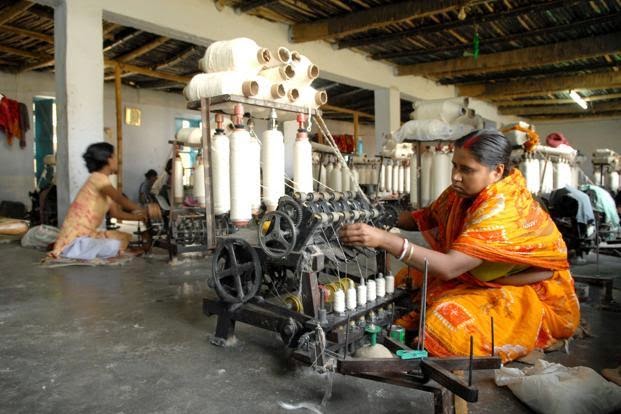
Chanderi is a cluster of about 3,500 weaving households in Madhya Pradesh that has been involved in weaving fine silk fabrics, including saris, for several centuries. It is just one of India’s estimated 545 traditional handloom weaving clusters and 2,000 traditional skills-based clusters.

These clusters suffer from apathy, exploitation by middlemen, poor market reach, bad health and education facilities, lack of alternative livelihood, poor civic amenities, broken government infrastructure and unfulfilled promises. However, all such clusters have one thing in common: they are populated by enterprising people who understand the meaning of profit and loss.

When I shared with our Latin American friends and Unctad how the fortunes of Chanderi changed in three to five years, they told me that they wanted to replicate the experience in their countries. I pointed out that the major change came from widespread connectivity, availability of Wi-Fi on demand, and connecting schools, shops, banks, offices, post offices, health centres and all those micro-enterprises to the Internet. Today, there is a dedicated centre where all silk fabric designs take place digitally and on machines by the weavers themselves, rather than on sheets of paper. Even big businesses and traders get their designs done from this digital design centre by paying a fee.

Products featuring mesmerizing weaving designs are available at chanderiyaan.net, an e-commerce portal. However, the real story is that most of the logistics related to photographing products, uploading them online, managing customers and couriering goods are all done by members of the local community with little outside intervention. According to a study by the Indian Institute of Technology, Kharagpur, Chanderi’s turnover from the weaving cluster has tripled simply by removing the information asymmetry.

The clear message is that each and every cluster in the country that can be classically defined as a traditional skill-based cluster could adopt a holistic approach to meticulously integrating digital tools and connectivity in each segment of the ecosystem and enjoy the story of a sustainable economic and cultural transformation.

While I hope that the Chanderiyaan model could be replicated across all weaving clusters of the country and perhaps several Latin American countries, too, we at the Digital Empowerment Foundation have our task cut out to replicate the model in at least three more clusters. Work has now started at Barabanki in Uttar Pradesh and Bargarh and Nuapatna in Odisha.

Digital marketing

Digital marketing helps you to find yourself in first place among the other competitors. We help you to strategically plan and execute your,product and services through our online platforms.Pixotri technology is a  creative house developing quality web designs, E-Commerce solution. SEO services and Gaming development .

Contact us for your Digital marketing requirements .email-info@pixotritechnologies.com. Visit our website: www.pixotritechnologies.com

Friday, May 8, 2015

Future Group banking on analytics to battle e-commerce companies

Ecommerce, customer relationship and marketing experts reveal the fastest ways to turn off shoppers and offer advice for what you can do to ensure customers don’t leave your site and make their purchases elsewhere.


In today’s super competitive, I-want-it-now mobile world, you only have a few minutes (or seconds) to engage potential shoppers. And if your site isn’t mobile friendly, considered trustworthy or a dozen other things online shoppers deem important, that potential customer will go elsewhere.

But never fear. Help is at hand. Following is a list of the 12 fastest ways to lose online shoppers and what you can do to prevent potential customers from buying from your competitors.

state of cios
State of the CIO 2015
More than 500 top IT leaders responded to our online survey to help us gauge the state of the

1. Your site is not mobile friendly. “With recent changes to Google’s search algorithm, businesses without a mobile-friendly site will appear farther down in search queries—in essence, eliminating them from relevance,” says Bill Nagel, cofounder & chief marketing strategist, Netsertive, a digital marketing intelligence company. “This is the fastest way for a business to lose a customer to a competitor as more than 90 percent of consumers use search to help them make a purchasing decision.”

To find out how mobile friendly your website is, “businesses can perform a quick mobile-readiness diagnostic check of their site through Google’s Mobile-Friendly Test tool,” he says. “This exercise will ensure that a business can be found online and can attract more qualified shoppers in 2015 and beyond.”

2. Your site is too slow. “The simplest way to turn off potential customers is with a slow, non-responsive website,” says Dan Carney, vice president of Operations at Limelight Networks, a content delivery network provider. “A recent survey shows that nearly 39 percent of customers will wait between 3 and 5 seconds for a website to load until they get frustrated and leave. [And] nearly 41 percent leave after more than 5 seconds,” he explains. “If [your] website is not performing quickly, then the customer will simply give up.” 

To avoid this problem, regularly test your load speeds, and make sure your site is up to speed.

3. Your site is clogged with banners and ads. “Given the size limitations of [some laptop] and mobile devices, space is at a premium,” notes Paras Mehta, CTO, ShoeBuy. “Your customers want to know they have arrived at the right place, for the right product, right now. Don't make them sift through [or overwhelm them with] a sea of marketing [banners and ads].”

4. Visitors don’t feel your site is safe or trustworthy. “Neglecting to show verification [that your] website is secure can result in low conversation rates for your company and a lack of trust from consumers,” says Harsh Sood, CTO, Fareportal. Indeed, “customers [often] refuse to buy goods or services from a site that is not secure due to the risk of identity theft or fraud. To increase conversion rates, and ensure you and your customers' protection, invest in solid security and encryption software,” he advises. Or make sure your hosting provider has.

“Brands that lack clearly defined authenticity policies [and trust marks] are more prone to creating a negative brand perception that may result in a loss of customers,” adds Matt Krebsbach, director of Global Public & Analyst Relations at Bazaarvoice. A Bazaarvoice survey found that 29 percent of U.S. consumers will not purchase from or enter personal information on websites that do not display appropriate trust marks.”


5. Your site is difficult to navigate. “There’s nothing worse than a website that is hard to navigate,” says Rob Garf, vice president, Industry Strategy & Insights, Demandware, a cloud commerce solution provider. “Retailers will lose customers if their sites aren’t easily searchable,” he argues.

“Get in the mind of the shopper,” he advises. “Consider how they will navigate [your] site to guarantee customers can find products they’re searching for.” And “test every element of the customer’s buying journey through every touch point on [your] site, to ensure high-speed and quality search functionality.”

To keep customers engaged, make sure they can find whatever it is they are looking for with just a couple of clicks.

e-commerce

Our successful eCommerce software solutions deliver an optional shopping experience for targeted prospects. Our solution creates fast, easy browsing and simple ordering and checkout process.Pixotri technology is a  creative house developing quality web designs, E-Commerce solution. SEO services and Gaming development.

Contact us for your online shopping requirements email-info@pixotritechnologies.com. Visit our website: www.pixotritechnologies.com


Thursday, May 7, 2015

Indian E-commerce Logistics Startup Delhivery Raises $85M Series D


In yet another vote of confidence for India’s e-commerce market, logistics company Delhivery has scored a series D round of $85 million, less than eight months after its $35 million series C.

The latest round was led by Tiger Global Management with participation from returning investors Multiples Alternate Asset Management, Nexus Venture Partners, and Times Internet Limited.

Delhivery currently has 10,000 employees in more than 200 cities and says that its 11 fulfillment centers cover more than one million square feet of warehouse space, which it plans to increase to 2.5 million square feet by the end of this year.

The startup claims to be India’s top e-commerce fulfillment companies, processing over three million monthly transactions for 70,000 merchants, 1,500 e-commerce companies, and 200 offline retailers.

In a prepared statement, Delhivery said it will use its series D on infrastructure to serve different kinds of e-commerce companies and verticals, including hyperlocal commerce, furniture, and e-commerce, as well as extend its reach in rural areas of India.

Delhivery is the latest logistics-focused e-commerce startup to receive fresh funding in India. Others include grocery delivery service Peppertap, which is helmed by the founder of Nuvoex, a delivery service provider for major e-commerce companies like Snapdeal, Flipkart, and Jabong, and on-demand delivery service Grofers.

India’s e-commerce market is expected to grow to over $100 billion in 2020, up from $2.9 billion in 2013, according to Morgan Stanley, which makes it the fastest-growing in the world.

The country’s logistics networks, however, still have a lot of catching up to do, especially if companies want to reach customers outside of major cities. According to the Economic Times, e-commerce companies in India have to build their own infrastructure, as opposed to the government help Alibaba and their other counterparts in China have received. Many companies rely on third-party logistics providers, like Delhivery, but they have to grow fast in order to keep up with demand.

Game development

The employees at Pixotri Game Studio have vast experience in creating games and are always trying to push the boundaries of technology and creativity. The games are created using the most popular game enigine Unity, which provides robust, high performance, platform independent solution to creating games.

Pixotri technology is a  creative house developing quality web designs, E-Commerce solution. SEO services and Gaming development .
Contact us for your mobile gaming requirements email-info@pixotritechnologies.com. Visit our website: www.pixotritechnologies.com