Showing posts with label facebook app. Show all posts

Friday, February 26, 2016

Facebook Reactions Are Not Wow

160224_USERS_Facebook-Reactions-Promo
In addition to the classic like, Facebook users can now also signal love, haha, wow, sad, and angry in their reactions to a post.

Last year, Dacher Keltner, a professor of psychology at the University of California, Berkeley, sent a document to a team of Facebook researchers called “Mapping the Hierarchy of Emotional Reactions.” Facebook was working on expanding its iconic like button to help users express a wider range of emotional responses, and it had enlisted Keltner—an emotions expert who also consulted on Pixar’s Inside Out—to help feel its way along. Keltner told Facebook that scientists recognize more than 20 basic emotions that are “communicated in the face or voice or both,” including shame, guilt, disgust, fear, relief, sympathy, and contempt, plus many more “subordinate” emotional states that describe “more specific” variations. Anger, for instance, can be expressed as irritability or rage. Pixar illustrator Matt Jones, who also worked on Inside Out, drew several dozen emotionally accurate emoticons to help bring each feeling to life. The “sulky” emoticon sticks out its bottom lip and turns its eyes to the ceiling. The one for “disagreement” narrows its eyes and turns the corner of its mouth down ever so slightly.


Amanda HessAMANDA HESS
Amanda Hess is a Slate staff writer. 

On Wednesday, Facebook rolled out its final set of emotional responses. It calls them “reactions.” In a piece published last month in Bloomberg Businessweek, Facebook emphasized the scientificunderpinnings of the new venture. As reporter Sarah Frier put it, the team “consulted with outside sociologists about the range of human emotion, just to be safe.” In addition to the classic like, users can now also signal love, haha, wow, sad, and angry in their reactions to a post. And that’s it—no sulking, no disagreement, no contempt, no shame.
“As a scientist, I’m always seeking a faithful representation of what people are really experiencing,” Keltner says. “I wish Facebook could include all of the emotions, so users could show their disgust or signal that they’re embarrassed. Fear would be really cool. I even lobbied for a ‘sympathy’ reaction that’s even more specific than ‘sadness.’ ” But Facebook isn’t in the business of scientific exploration. Says Keltner: “They’re constrained by the size of a smartphone.”
The new reactions aren’t designed to help users express how they really feel. They function more like patches for all those times when a like seems insufficient or inappropriate. “When I see that my friend got engaged to her college sweetheart, I can ‘like’ that, and that’s fine, but what I really want to do is say that I ‘love’ that that happened,” says Sammi Krug, the project manager for the reactions feature. “And on the opposite end of the spectrum, when I see that a friend from home’s family pet of 17 years has passed away, that’s a prototypical example of a case where ‘liking’ that post doesn’t feel right to people.”
It’s important to Facebook that its users know exactly what reaction “feels right” in every situation. A dislike button, Businessweek reported, was “rejected on the grounds that it would sow too much negativity.” (Does my friend dislike climate change, or dislike my post about climate change, or dislike me?) And though the platform originally mulled releasing an additional button it called yay—a smiling yellow face with contentedly closed eyes and flushed pink cheeks—it scrapped it before launch. Kruger says the reactions team was pushed to create “a global product” where “every single reaction is useful across all the users on Facebook” and “each and every reaction is universally understood.” Facebook began rolling out reactions to users in Spain, Ireland, Chile, Portugal, Japan, Colombia, and the Philippines this past fall before going global this week. Initial tests, Kruger says, determined that yay felt “too vague.”
That’s weird. It’s hard to imagine a more universal symbol of emotional expression than the smiley face. And after all, the like button—a thumbs-up rendered in Facebook white and blue—was not built on a universal symbol of positivity. As Brendan Koerner explained in Slate in 2003, a fist with an upturned thumb is “a crass Middle Eastern insult.” The gesture also registers as rude in Australia and Nigeria. In Germany, extending a thumb is how you count to the No. 1. The problem with yay isn’t that users don’t agree on what it means. It’s that there’s no specific reason to use it instead of the other happy-go-lucky reactions: love, haha, or the old-fashioned like.
My colleague Will Oremus wrote on Wednesday that the expansion of the like button can help Facebook “start to gather much more nuanced data on how users are reacting to any given post.” Include too many options, and that utility fades. If it’s not clear why users would choose a yay reaction over a love reaction, then the data is meaningless. Facebook’s business model relies on aggregating and interpreting data on a massive scale, so it makes sense to focus on developing behaviors that can be understood in the aggregate.
In doing so, Facebook is fighting against the tide of Internet culture. Online creators now make their marks by filming reaction videos, cutting and posting reaction GIFs, and roasting or remixing original works. The vast emoji keyboard allows us to create new meanings for obscure glyphs, a la the Japanese eggplant emoji that’s evolved into a symbiotic stand-in for a penis, or the newly released “thinking face” emoji that’s quickly been repurposed as a tool for casting shade. Last year, Twitter rolled out a new “quote tweet” feature that showcases replies as their own statements—it’s less about engaging in conversation and more about stepping on someone else’s tweet and repurposing it. And in contrast to Facebook’s slim pickings, the office chat product Slack allows users to access the complete emoji keyboard, and even make their own emoji. The endless options encourage puns, inside jokes, and emotional communication that feels more heartfelt because each emoji is individually, carefully selected.
Facebook’s limited set of responses feels strangely more constricting than the solitary like button. The Facebook like, the Instagram heart, and the Twitter fave (recently rebranded as a like, too) are all just sunny euphemisms for a gesture of generalized acknowledgement. The like button was a nod. It said: “I see you.” Maybe it was meant to mean “I like the content of this post,” but it often felt like “I like you.” But the additional responses complicate that reading. Now a simple like risks feeling like: “I like this, but I don’t love it.” Or: “I acknowledge you’ve made a joke, but I won’t pretend it made me laugh.” Or “I know I have the option to signal that I’m sad about your dog dying, but I’m inconsiderate or dastardly enough to just like it anyway.”
Researchers like Keltner are still puzzling out what it means to “react” emotionally online. One possibility is that Facebook users are “expressing a feeling they’re actually feeling” when they send a sad face or a laughing one to a friend. But it’s also possible that the symbol is just “a referential expression,” Keltner says. It says: “I recognize that what you’ve done could produce this feeling, but I don’t necessarily feel it.” So, “if someone posts that they haven’t turned in their taxes, I might respond with an expression of fear even if I don’t feel fear,” Keltner says. “It means that I recognize that it’s a fearful situation.”
Perhaps that means that reactions will end up meaning next to nothing. When you look at a recent post, you’ll see a count of the total number of Reactions and likes: the raw number of people who responded to your little joke or tortured confession. The sheer number of reactions is elevated above their emotional content. When you receive a crying symbol or a laughing one on a post, you may not even notice which of your friends has expressed sadness or delight. All that matters is how many people have recognized you.

Facebook Officially Launches Canvas Ads That Load Full-Screen Rich Media Pages In-App


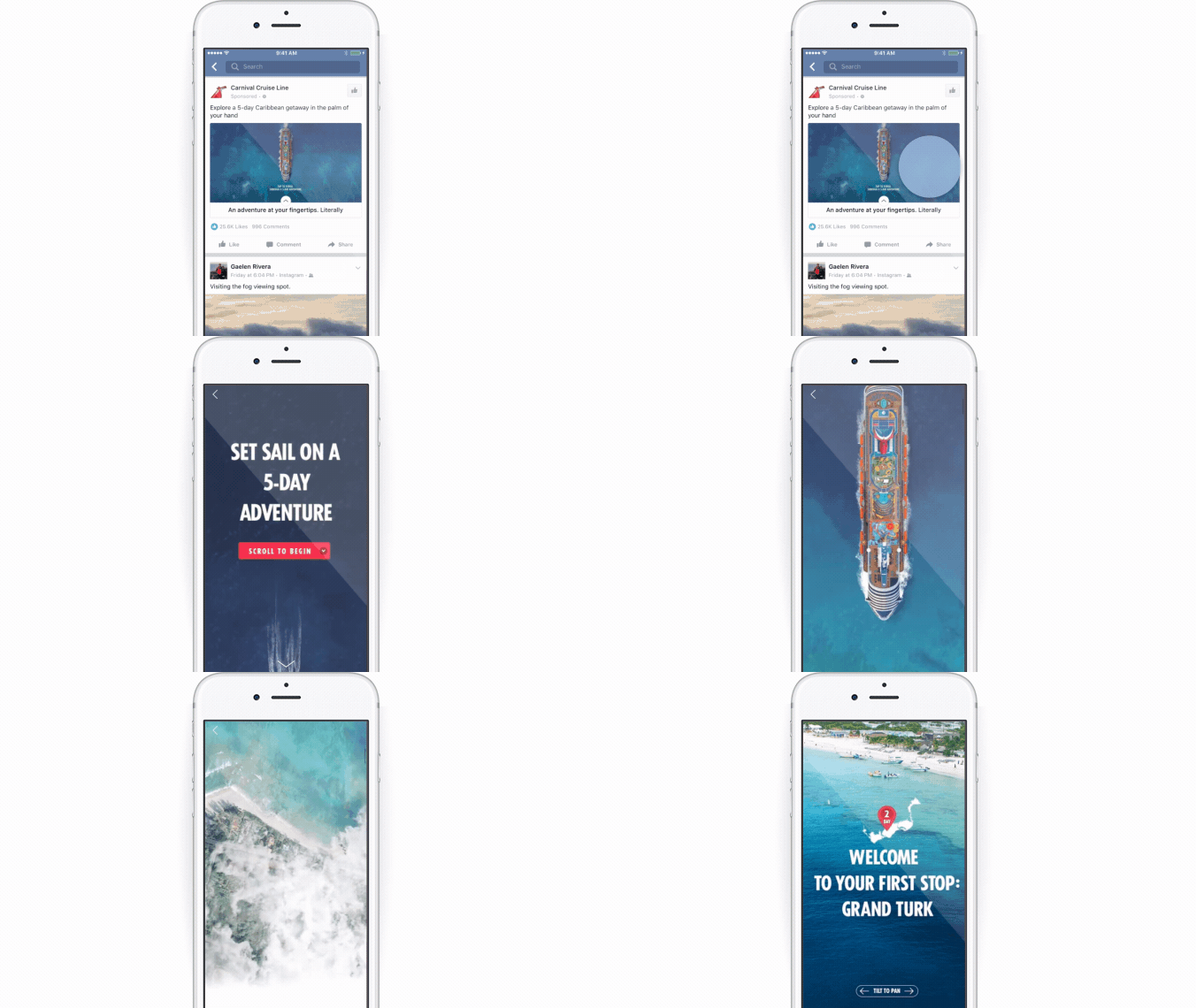
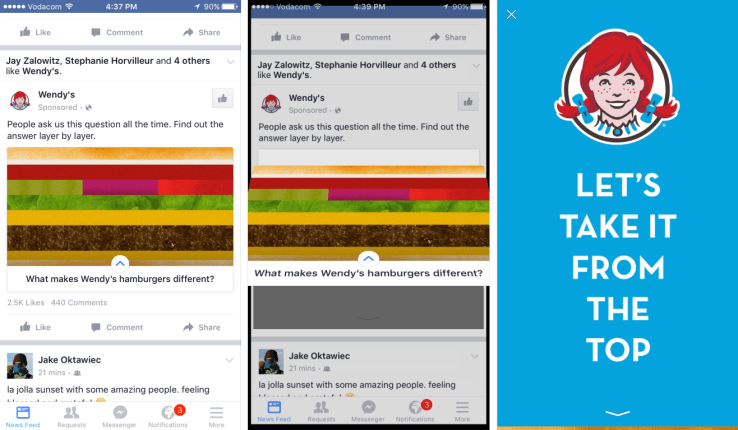
Instant Articles, meet Instant Ads. Facebook wants to give advertisers an immersive way to reach people without making them leave the social network. So today it officially launched its ad Canvas for all advertisers. When users click a Facebook News Feed ad connected to Canvas, it opens a full-screen, rich media page inside of Facebook rather than forcing users to wait for a mobile website to load.
12765831_693974300742934_571885871_n
Last year Facebook started testing Canvas, which I called Instant Articles for ads. The impetus was that mobile sites have tripled in size since 2011, leading to five to ten second load times users don’t want to sit through to see an ad. The types of rich media marketing experiences that people actually remember load far too slow on mobile. So Facebook built the endpoint of ads into its own app so it can pre-load and show them in about one second.
Canvas removes constraints that low-power mobile sites put on content. Facebook Canvas allows interactive elements like animations, carousels, product catalogs, tilt-to-view images, and videos. Canvases appear linked to from News Feed ads on iOS and Android, and Facebook is evaluating how to expand this to other versions and apps such as Instagram.
Facebook Canvas
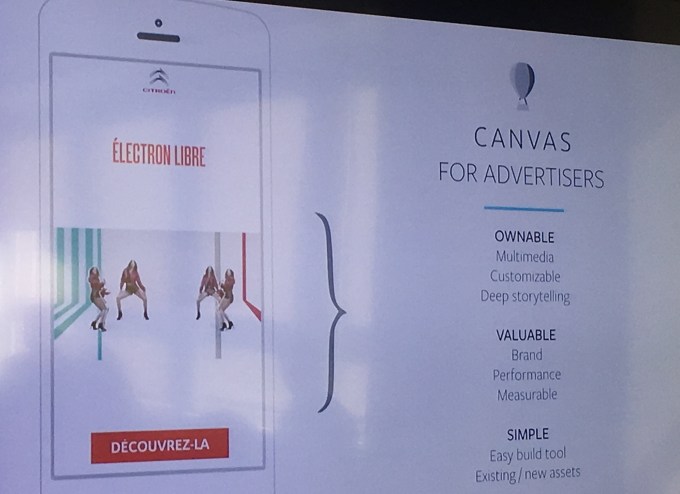
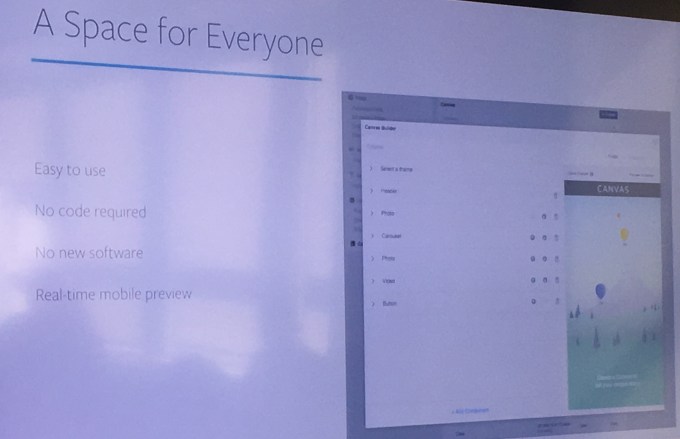
Brands can build Canvas ads with a self-serve tool. There’s no code required. Facebook’s design tool lets them just drag around images, GIFs, videos, and more, then set attributes and start showing their ad. Facebook ad exec Mark D’Arcy joked that “The only thing they can’t make, really, is excuses.”
Advertisers can sign up to use Canvas here. There’s no additional cost to build a canvas ad. Businesses just pay for the same News Feed ads as always, but get to build a better destination where they lead. Different versions of a Canvas can be targeted to different demographics just like normal Facebook ads.
Facebook says Canvas won’t lead to more ads on Facebook. Users can identify Canvas ads by a little upwards arrow that denotes that the full-screen experience will unfold.Facebook Canvas Builder
Facebook says the early tests of Canvas have shown users actually want to stick around and experience the ads. 53% of users that open a Canvas view at least half of it, and the average view time is a stunning 31 seconds. The top Canvas ads can see more than 70 seconds of view time per user.
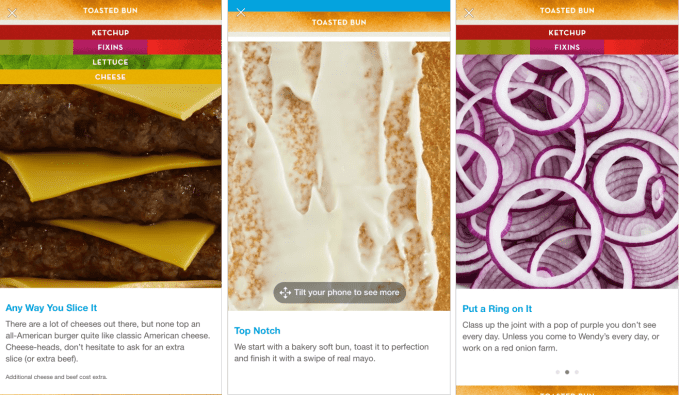
In this Canvas campaign where Wendy’s deconstructed a cheeseburger and let people scroll, swipe, and see GIFs of different ingredients received 65 seconds of average view time. 2.9% of viewers even got all the way to the bottom and used the Wendy’s restaurant locator.
instant-ads-rich-media1
Storytelling through ads has been a big push for Facebook recently as it tries to squeeze out more revenue per user, especially developing world markets. Last year it launched the Creative Accelerator to teach brands how to build ads for slow mobile networks and feature phones, and launched a special Slideshow ad format that mimics video but loads quickly. But Canvas is the other end of the spectrum — high-bandwidth ads for the first world.
unnamed-file
By giving advertisers a richer format to market through, it can make sure viewers remember them. While lots of platforms are competing for ad dollars, none have innovated in the destination those ads lead to. And since Canvas doesn’t frustrate users with long load times or tempt them to leave Facebook through the browser, the social network can keep them rattling around and seeing more of its News Feed ads while they connect with friends.
Screen Shot 2016-02-25 at 10.12.05 AM

Tuesday, February 23, 2016

Facebook is using its photo-tagging technology to create incredibly detailed maps of where you live


Artificially-intelligent machine learning technologies that allow computers to “learn” to recognize patterns and make judgments have been used to translate languages, recognize objects in photos, and filter email.
Now, Facebook is using its own expertise in computer vision — the image-analysis technology that powers the social network’s photo tagging features — to create detailed maps of where people live and how factors such as population density impact their ability to connect to the Internet.
So far, the effort has yielded maps of 20 countries, particularly focusing on identifying buildings and other man-made structures in rural and remote areas.
The highly-detailed maps could also be used for other purposes, such as improving responses to natural disasters, the company said in a blog post announcing the effort on Monday.
The effort is part of Facebook’s Connectivity Labs, which oversees the technical aspects of the social network’s Internet.org effort, including its large solar-powered Aquila drones, which the company hopes to use to deliver high-speed Internet to a 50-mile area.
A team of researchers from the group worked with the company’s data science, artificial intelligence, and machine learning teams to analyze 350 terabytes worth of images that covered 21.6 million square kilometers across all the countries.
The maps could be particularly useful in determining how best to provide Internet access to people in the developing world, whether through traditional wireless or cell tower connections or more unusual means like drones, satellites, and lasers, the company says.
“The basis of this stems from being able to have accurate models of where people in the world are,” Yael Maguire, who oversees Facebook’s Connectivity Lab, told Fast Company. “The data that [already existed] was somewhat inadequate to build adequate models for where” newer technologies, such as drones and satellites could be use most efficiently.
FacebookA Facebook engineer codes at his desk.
Using computer vision techniques, the researchers were able to identify man-made structures, which they are using as a proxy for people living in a particular area.
They created the maps using a three-step process that first discarded images with large, non-man-made features, such as deserts, forests, and water, then detected whether a satellite image contained a building.
Lastly, the researchers  “trained” a neural network using a relatively small number of images — about 8,000 — to identify buildings in other countries while filtering out areas that didn’t contain man-made structures. They then redistributed census count of local populations equally over the buildings identified by the computer.
“This method assumes equal population distribution per building within a census area, which we felt was the least error-prone method of obtaining population densities since it doesn’t make any assumptions on the number of people per building and constrains systematic errors to within one census area,” wrote researchers Andreas Gros and Tobias Tiecke in the blog post.
In addition to using a relatively small number of images to train the network to recognize buildings, the effort also improves on the resolution of existing population density models. While many are currently at a resolution of 1 kilometer, Facebook’s model offers data at a resolution of 5 meters, the researchers note.
In addition to its own efforts to improve Internet connectivity, the company also plans to release its work to the public later this year, including releasing a combined population data set developed with researchers from the Center for International Earth Science Information Network at Columbia University.
Thomson ReutersFacebook CEO Mark Zuckerberg speaks on stage during a town hall with Indian Prime Minister Narendra Modi at Facebook’s headquarters in Menlo Park, California
The project has mapped Algeria, Burkina Faso, Cameroon, Egypt, Ethiopia, Ghana, India, Ivory Coast, Kenya, Madagascar, Mexico, Mozambique, Nigeria, South Africa, Sri Lanka, Tanzania, Turkey, Uganda, Ukraine, and Uzbekistan, according to Fast Company. 
The new maps join a growing number of machine learning tools developed by tech companies that have been released to the public in recent months, including Facebook’s own Torch, Google’s Tensor Flow, Microsoft’s CTNK software toolkit, and forthcoming efforts from the Open AI research collaborative funded partly by Tesla head Elon Musk.
The Facebook researchers say the mapping project could have a variety of uses in addition to improving how users in rural parts of the world go online. It could help validate census data, aid socioeconomic research, and be used to create risk assessments for natural disasters that could improve the response from agencies around the world. Making the project publicly available greatly improves the ways in which the tools can be used, one industry expert says.
“Data about human populations—whether farm output or population density—is costly and slow to obtain,” Mark Johnson, chief executive of Descartes Labs, which analyzes satellite imagery for the agriculture industry, told Fast Company. “The most exciting thing about Facebook’s work is not just about the population density of today, but looking backwards to see trends and running this analysis as new, better satellite imagery is available.”

Facebook “Birthday Cam” Encourages Videos, Not Robotic Wall Posts


Birthdays on Facebook have become a dystopian chore. Typing “HBD” or just “Happy Birthday!” on a friend’s profile is basically the least human way to interact with them. So Facebook is pushing people to record more intimate greetings with its new Birthday Cam feature launching today on iOS.
A banner on the birthday boy or girl’s profile will solicit you to capture a video message up to 15 seconds long. You can then add special birthday frames before sharing it on the friend’s wall. Oddly, the videos only appear separately rather than compiled into something more watchable. Even if you just say “happy birthday,” it’s still a lot more unique than typing it.
Facebook Birthday WallOver the years as Facebook has grown into a ubiquitous utility, it’s also developed some strange emergent behaviors. From pity liking to inviting friends to events thousands of miles from where they live, we do weird things to make our friends feel appreciated without going to much effort.
“Happy Birthday” wall posts are perhaps the most ingrained of them all. Since the early days of Facebook, it’s given you a heads-up on friends’ birthdays. That spawned the practice of posting something — anything — on their wall.
Typically it’s a generic “happy birthday,” but you always get those few actually considerate friends who at least throw in a meme, add a photo of you two, or conjure up a memory. It was always nice to skim through the posts on your cake day, and even count them and compare the number to previous years to see if your social life is up and to the right, or in need of restructuring.
Yet with time, the yearly habit lost some of its luster. The messages eventually felt repetitive and Facebook’s evolution on mobile saw upcoming birthdays moved from the web home page to the bottom of the Events tab on mobile. Perhaps the Birthday Cam can breathe some new life into one of Facebook’s oldest rituals.

Monday, February 22, 2016

Filipinos’ messaging tool of choice: Facebook Messenger


Facebook-Messenger

In Southeast Asia, Instant Messaging (IM) has emerged as the most popular messaging tool, with IM usage increasing and SMS decreasing across the board, except in the Philippines.
Filipinos still prefer to use SMS (73 percent), but those who use IM (33 percent) turn to Facebook Messenger instead of pure Over-The-Top (OTT) IM services to communicate: 94 percent of Filipino IM users use Facebook Messenger, an app that has been downloaded three times more than Skype and 10 times more than WhatsApp in this country.
Deloitte’s Global Mobile Consumer Survey 1
This is according to Deloitte’s Global Mobile Consumer Survey, which was released by Navarro Amper & Co., the local member firm of Deloitte Southeast Asia Ltd. Conducted in the third quarter of 2015, the survey covered 49,500 consumers across 31 countries to reveal some of the trending attitudes and behaviors of today’s mobile consumer. In Southeast Asia, 6,000 respondents from Indonesia, Malaysia, the Philippines (1,000 respondents), Singapore, and Thailand were polled.
The popularity of IM will continue to hold in the region, with Filipinos finding it a convenient option for chatting with friends and family overseas.
“Telecommunication operators can take advantage of this situation to increase revenues from data usage,” says Greg Navarro, Managing Partner & CEO of Navarro Amper & Co. “They can, for example, tailor chat packages to specific IM applications that are widely used in their respective local markets.”
When it comes to internet speeds, consumers in Southeast Asia are generally satisfied with their service providers but they want greater data volumes in their plans. In the Philippines, there was a drop in respondents who are satisfied with their internet speeds – from 49 percent in 2014 to 39 percent in 2015; not surprising considering the country reportedly has the second slowest internet speed in the Asia Pacific region. And only 38 percent of Filipino consumers are satisfied with their data volumes, an increase from last year’s 31.2 percent.
The survey also revealed that Internet network reliability is the top consideration for Filipinos when choosing a mobile operator, followed by price package and 4G/LTE network availability. Even consumers who are satisfied with their internet connection may change operators for either of these factors, which makes sense considering how reliant consumers are on their phones.
Deloitte’s Global Mobile Consumer Survey 2
Within 15 minutes of waking up, 79 percent of Filipino mobile phone users have already checked their phones, compared to more than half of mobile phone users in Southeast Asia. They also glance at their screens repeatedly, using their phones most frequently when commuting on public transport. It’s also worth noting that compared to other SEA countries, in the Philippines there is a significant proportion of users – 31 percent – who listen to online radio via their smartphones.
Respondents were also asked how they connect to the internet based on their location. Eighty-two percent of Filipino respondents said they use Wi-Fi at home, in the workplace, or their place of study; only 25 percent of Filipino respondents use Wi-Fi in public places.
“Again, there’s an opportunity here for telecom operators to monetize Wi-Fi for consumers on public transport facilities,” says Navarro. “And with the government’s project to provide free Wi-Fi in underserved areas of the country, it will be interesting to see how these statistics and behaviors change over the next few years.”Deloitte’s Global Mobile Consumer Survey 3
Another capability worth exploring for telcos is mobile payment. Across the Southeast Asian countries polled, majority of respondents are willing to use mobile-based, in-store payment solutions – in the Philippines, 62 percent of respondents are willing to give it a try – but these respondents say there is a lack of availability of such solutions, and when it is available, it entails slower processing times compared to cash or credit card transactions.
“Telecom operators that want to take advantage of this functionality need to offer solutions that enable simple and quick transactions. They also need to improve payment security, so that consumers can be comfortable using mobile payments even for big ticket transactions, and expand the number of point-of-sale terminals that accept mobile payments,” says Navarro.

Wednesday, October 21, 2015

Facebook rolls out instant articles to all iOS users and announces an Android beta

Five months after introducing its fast-loading instant articles into the News Feed, Facebook is now rolling out the format to all iPhone users, the company said today. Speaking at The Wall Street Journal's WSJD Conference in Laguna Beach, California, Facebook's Chris Cox said thousands of articles a day will now be published as instant articles. Facebook will also test the format in a public beta for Android users that launches today, said Cox, Facebook's chief product officer. Instant articles for Android will become widely available later this year.
Facebook is also adding new partners to the instant article program, including Vox Media (parent of The Verge), SlateThe Huffington Post, and The Daily Mail. They join the company's original nine partners, which include The New York TimesBuzzFeed, and The Atlantic. Publishers' interest reflects the enormous percentage of traffic that Facebook drives to their properties — and their fears over being left out if the faster-loading stories soon crowd out the regular old URLs that have been their lifeblood for the past several years.
PUBLISHERS ARE SCRAMBLING TO SUPPORT THE NEW FORMAT
Facebook says readers are more likely to share instant articles, and that they load 10 times faster than normal links. Articles that are shared more often typically rank higher in the News Feed, which helps explain why publishers are scrambling to rewrite their content management systems to support the format. Meanwhile, rival quick-loading formats have been introduced by Apple, through Apple News, and Google, with Amplified Mobile Pages.
But it's Facebook that dominates news reading these days, and the breadth of publishers that have agreed to support the new format is telling. Here they are: BillboardBilly Penn,The BlazeBleacher ReportBreitbart, Brit + Co, Business Insider, Bustle, CBS News, CBS Sports, CNETComplexCountry LivingCrackedDaily DotE! NewsElite Daily,Entertainment Weekly, Gannett, Good HousekeepingFox Sports, Harper's Bazaar,Hollywood LifeHollywood ReporterIJ ReviewLittle ThingsMashableMental Floss,mindbodygreen, MLB, MoviePilot, NBA, NY PostThe Onion, Opposing Views, People,Pop SugarRare, Refinery 29Rolling StoneSeventeenTIMEUproxxUS Magazine,USA TodayVarietyThe Verge (hey that's us), and The Weather Channel.
Instant articles are denoted in the feed by a lightning bolt next to them. You'll see them if you follow any of the publishers above, or if a friend shares them. While they load faster than normal articles in part by stripping out advertising and tracking code that runs on many web pages, they also can include various custom visual elements, including 3D maps and photos that can be browsed by tilting your phone.
Correction, 1:30 p.m.Clarified that while instant articles for Android will become widely available later this year, the public beta will launch today.

Visit our website:  www.pixotritechnologies.com  , http://pixotrigames.com/

Wednesday, April 22, 2015

The company announced key changes to what content it displays in your News Feed


Facebook said Tuesday it will increase the amount of content from close friends appearing in users’ News Feeds.

The social network announced three key changes to the content displayed in News Feeds, saying it was responding to feedback from users. “As more people and pages are sharing more content,” product manager Max Eulenstein and user experience researcher Lauren Scissors detailed in a statement, “we need to keep improving News Feed to get this balance right.”

For starters, people who don’t have much content to see will start seeing, well, more content. Facebook said it would lift restrictions on seeing multiple posts from the same source appearing in a row.

For users with more connections who find that they are missing important posts from friends—often in favor of media or corporate posts—Facebook said it would ensure that they would see more by showing those photos, status updates, links or videos higher in the News Feed, making them less likely to glance over it.

And in another change that is likely to draw support from users—and potentially dismay from advertisers—Facebook said it will pull back on the prevalence and prominence of posts about your friends liking or commenting on others’ posts. The stories will either appear lower in the News Feed or not at all.

Facebook warned that the changes may cut into traffic to some pages, saying the “impact of these changes on your page’s distribution will vary considerably depending on the composition of your audience and your posting activity. In some cases, post reach and referral traffic could potentially decline.”


SEO solution

We employ a variety of proven recommended techniques to increase your chance for top rankings.These include optimizing your website's page,content,and structure to drive traffic to your site for specific keyword research.Pixotri technology is a  creative house developing quality web designs, E-Commerce solution. SEO services and Gaming development .

Contact us for your SEOrequirement. email-info@pixotritechnologies.com. Visit our website:        www.pixotritechnologies.com

Tuesday, April 21, 2015

News Feed FYI: Balancing Content from Friends and Pages


The goal of News Feed is to show you the content that matters to you. This means we need to give you the right mix of updates from friends and public figures, publishers, businesses and community organizations you are connected to. This balance is different for everyone depending on what people are most interested in learning about every day. As more people and pages are sharing more content, we need to keep improving News Feed to get this balance right.

What are today’s updates?

We get a lot of feedback from people and recently started asking people to rate their personal News Feeds to tell us how we can improve. Based on this feedback and our ongoing understanding of how people use News Feed, we are making three updates. The first is improving the experience for people who don’t have a lot of content available to see. Previously, we had rules in place to prevent you from seeing multiple posts from the same source in a row. With this update, we are relaxing this rule. Now if you run out of content, but want to spend more time in News Feed, you’ll see more.

We’ve also learned that people are worried about missing important updates from the friends they care about. For people with many connections this is particularly important, as there is a lot of content for them to see each day. The second update tries to ensure that content posted directly by the friends you care about, such as photos, videos, status updates or links, will be higher up in News Feed so you are less likely to miss it. If you like to read news or interact with posts from pages you care about, you will still see that content in News Feed. This update tries to make the balance of content the right one for each individual person.


Lastly, many people have told us they don’t enjoy seeing stories about their friends liking or commenting on a post. This update will make these stories appear lower down in News Feed or not at all, so you are more likely to see the stuff you care about directly from friends and the pages you have liked.


SEO solution
We employ a variety of proven recommended techniques to increase your chance for top rankings.These include optimizing your website's page,content,and structure to drive traffic to your site for specific keyword research.Pixotri technology is a  creative house developing quality web designs, E-Commerce solution. SEO services and Gaming development .

Contact us for your SEOrequirement. email-info@pixotritechnologies.com. Visit our website:        www.pixotritechnologies.com