Showing posts with label default search engine. Show all posts

Tuesday, May 5, 2015

7 SEO Fundamentals More Important Than Link Building


Link building has been a subject of controversy for the past few months, as comments from Google’s own John Mueller and evidence from the latest round of the Penguin update have called into question the overall legitimacy of link building as an SEO strategy. 

Up until recently, link building was considered to be indispensable to any SEO campaign—because Google considers the quantity and quality of external links pointing back to a domain as a major indication of that domain’s authority, it only made sense that building more links would have a proportional effect on increasing that authority.

However, Google appears to be cracking down on the practice of external link building, putting new regulations in place to closely scrutinize the quality of external links and in most cases, recommending that search marketers avoid the practice altogether. The SEO community has responded in a deep divide, with one side claiming that link building should be avoided at all costs and the other insisting that it’s still a viable strategy.

I believe that link building is still an important part of any SEO campaign, because correlation studies continue to indicate that links have the heaviest impact on the ranking algorithm, but I do recognize that its power has weakened and its risks have increased in recent years. While inbound links are essential for any SEO campaign, link building as a tactic is no longer essential.  Instead, a quality content strategy which attracts links like a magnet (rather than engaging in outbound efforts to acquire links) appears to be what Google is trying to nudge webmasters toward. Still, there are dozens of other fundamental factors far more important than link building that should take immediate priority. These are some of the most important:

1. Mobile Optimization. 

First, make sure your site is optimized for mobile. After Google’s recent “Mobilegeddon” update, there’s now no excuse for having a site that isn’t mobile-compatible. Hopefully, your site is responsive, which will allow it to be viewed consistently no matter what type of device is used to access it. Without some level of mobile optimization, your site may be doomed to low search visibility. Beyond that, it’s worth optimizing your site for speed as well—the faster your pages load, the better your overall user experience will be, and Google will rank your pages higher as a result.

2. Site Navigation.

 Google rewards sites that make it easy for users to find what they want, whether that’s information, a service, or a particular product. Optimize your navigation so it’s easy to find any page; the common way to do this is to group your pages in a single, minimalist navigation bar with descriptive core headings and full lists of pages underneath. It’s also helpful to include a search bar and interlink your content deeply so no single page of your site is ever more than two or three clicks away. Your goal should be getting your users to their ideal destination as quickly and easily as possible.

3. Full, Informative Content. 

Every page of your site needs to have a full section of descriptive, accurate content. On your home page, users should be able to immediately tell what your business is. On your About page, you should list important facts about your company. On your Contact page (and home page), you need to list your business name, address, and phone number at the very least. The more accurate and the more thorough your content is, the higher you’re going to rank.

4. Regular Ongoing Content. 

Without an ongoing content strategy program to support it, an external link building campaign is practically useless. Every business needs to be developing and publishing least one new piece of content every week—the more the better. This content needs to be wholly original, informative, and useful for its target audience. Without that ongoing fresh content, your site will quickly fall to the competition.

5. A Social Media Presence. 

And by a social media presence, I don’t mean a stagnant or token presence on Facebook and Twitter. If you’re going to get social, you need to get involved. Claim your business’s profile on as many social media platforms as you can, and post regularly on those platforms. Work to build contacts, connections, and a real ongoing community with syndicated content, company updates, and of course exclusive offers. The greater your social presence is, the higher esteem you’ll hold with Google. For more on social media marketing, see my eBook, The Definitive Guide to Social Media Marketing.

SEO solution

We employ a variety of proven recommended techniques to increase your chance for top rankings.These include optimizing your website's page,content,and structure to drive traffic to your site for specific keyword research.Pixotri technology is a  creative house developing quality web designs, E-Commerce solution. SEO services and Gaming development .

Contact us for your SEOrequirement.email-info@pixotritechnologies.com. Visit our website:        www.pixotritechnologies.com

Saturday, April 18, 2015

SEO for small businesses: getting noticed is easier than you think


Over the past decade, search engine optimization has changed dramatically. What once consisted of trying to outwit an algorithm has now evolved into a sophisticated art of audience targeting, centered around delivering tangible value to prospects and customers.

Good SEO gives small businesses the opportunity to cut through the Internet’s noise and reach the right audience with valuable content designed to help readers solve their business problems. But where should they start?

We spoke with Todd Friesen, Director of SEO at Salesforce, to learn more about what small businesses need to know for SEO success.

The topic of SEO can be confusing. There are so many different viewpoints on what to do and what not to do. What should small businesses do if they haven’t focused on this area of their business?

As a small business, SEO can be daunting. You type your products and services into the almighty Google and you see big businesses and national brands in the top slots. You’re standing at the bottom of a steep hill looking up. What are you, as a small business, going to do to compete? You’re going to buckle down and focus on what’s important.

Okay, where should they start? What are the fundamentals to know?

The Google Webmaster Guidelines are a great place to start, and will help you build your website in a way that Google and Bing can easily crawl your website and abstract the information they need to rank your website appropriately. Your HTML should be clean  and your site should load as fast as possible. All search engines want to provide their users with the best experience possible. If your site loads slowly or cannot be crawled easily, you will lose points — because if Google can’t retrieve and understand your website, they assume their users can’t either.

You should also provide a proper XML sitemap to clearly define the exact pages that a search engine should be interested in and crawl. This should NOT include URLs that have session IDs or tracking parameters in the URLs. These parameters can create massive content duplication issues and dilute your internal linking and page authority.

Bing and Google both offer a suite of Webmaster Tools that can help you asses these issues and more. Every webmaster should be using these tools from the largest corporate empire to the smallest one-man business on the corner.


Define and track your keywords. It is vitally important that you know the keywords and phrases that your potential customers are using to find you and your competitors. This allows you to focus your content. It’s not about just getting people to your site. It’s about getting the right people to your site.

Competitive research is step one when it comes to keywords. Researching the paid search landscape of your competition will reveal a host of keywords that are worth looking at. If someone is willing to buy that traffic, there are good odds those keywords convert to sales.

My go-to tool for this is www.semrush.com. You can easily and quickly see the keywords you and your competitors are ranking for, the keywords they are buying, and the estimated volume of searches Google gets on a monthly basis. SEMRush is also an excellent tool for tracking your keyword rankings on a regular basis. If you don’t have the right keywords, the best website in the world with the best content in the world will not reach the right audience.

You mentioned focusing on content. Why is content so important to SEO?

Search engines want content. They want new exciting things for their users to find and engage with. Here, we’re talking about top-quality content, not content for the sake of content. As a small business, one of your best assets is, very often, your level of expertise and customer service. You can parlay this into becoming a recognized authority with your content. This content will be consumed and passed around and linked to. This is link-building.

So it’s a good, cost-effective tactic: social SEO.

Yes, it’s where the content you’ve been creating really starts to kick in. While people may passively find and consume your content, in order to really get the ball rolling — to get your content spread around, consumed, and producing links for you — you need to get social. Go find all the social profiles you can. Twitter, Facebook, and other mainstays are obvious, but there thousands of social sites out there that cater to a wide variety of interests. Find your customers and promote directly to them while offering help and expertise. If you simply show up as a promotion machine, you will be discounted and your content development efforts will have been wasted.

What else can SMBs do to stay competitive with larger companies?

Localize. Localization is a significant opportunity for small businesses that have a physical address. Each month, there are billions of searches with local intent. With the latest developments in personalization and localization, search engines are serving customized results based on specific searches and user location.

For example, when you search for “pizza” on Google, you get results that show businesses with locations nearest to you.  Localization is about consistency and registration in all the appropriate databases. This is one area when the easiest path is to use a local registration service like www.alllocal.com to take on this project for you. The relationships between the sources are complex and time-consuming to manage on your own. Search engines access this data to confirm the reliability of their local results.

Any last pieces of advice for small businesses?

SEO is a vital part of the marketing mix for small businesses online, but if you master the fundamentals and spend your time focused on quality content, in the right place, with the right keywords, you can add value to your customers and dollars to your bottom line.

SEO solution
We employ a variety of proven recommended techniques to increase your chance for top rankings.These include optimizing your website's page,content,and structure to drive traffic to your site for specific keyword research.Pixotri technology is a  creative house developing quality web designs, E-Commerce solution. SEO services and Gaming development .

Contact us for your SEOrequirement. email-info@pixotritechnologies.com. Visit our website:        www.pixotritechnologies.com

Tuesday, March 24, 2015

How to Exceed 100,000 Blog Visits Per Month


If you want to be on top of your SEO game, you need to have great content. But simply putting out lots of crappy blog posts that no one reads or cares about won’t help you cozy up to Google. According to an SEO “Food” Pyramid I constructed, your site architecture is still the base of great SEO – but next on the list is quality, authoritative, relevant content.
To demonstrate this, I put together a case study of how a SaaS startup grew their blog traffic to over 100,000 visits/month using content marketing as an SEO strategy.


A Case Study

One of the posts we did at my last company, When I Work, back on March 6, 2014 – is still the post that drives the most organic traffic to our site. When we first published it, we saw only 319 visitors to the post for the entire month. This slowly started to climb, and as the topic become even more relevant, it skyrocketed to a high of 1,706 page views in one day.


The post has now generated over 89,000 pageviews for this blog post alone, many of whom have gone on to subscribe to the blog, and even become paying customers (I want to note that roughly 300                         of those visitors did come from paid promotion).


An Idea

It starts with a good idea. Not an idea that you think is good, an idea that your ideal audience thinks is good. Take a look at the Seven News Values: Impact, Timeliness, Prominence, Proximity, Bizarreness, Conflict, Currency. The more of these your idea can touch, the more likely your post will do well.

For our post about the minimum wage, we were able to hit on:

Impact: Almost everyone’s life will be impacted by a minimum wage discussion. Either you make the minimum wage, you manage people who make the minimum wage, or your friends, loved ones make the minimum wage.
Timeliness: It was being discussed during election/political chatter – which works out nicely for a post about minimum wage.

Conflict: There are heated debates on both sides of the minimum wage issue – there always will be.
Currency: Obviously, the minimum wage deals with money. And people talk about money.

Keyword Research

Moz already has a great guide about keyword research, so I won’t reinvent the wheel here – but my favorite tool is still the AdWords Keyword Planner.

We did some research trying to figure out what the best words were to use for the title, for the body, and for the intro paragraph. Keywords are not as fashionable, but they are still important – the goal has just shifted away from using keywords to trick Google, to using keywords in a natural conversation that makes the post easier to read by human beings.

We used the Keyword planner to find different ways of saying the same thing – maybe even ways that we didn’t realize other people used to describe what we were writing about. There can be a lot of regionality in how you talk about things – sort of like the word pop versus soda versus coke.

The keyword planner helped us see the different ways people phrased things so we could fit them into our content naturally and provide a better reading experience for more people.

Ask For Engagement

By asking people to comment we were able to increase the time people spent on the page. The title wasn’t misleading so visitors weren’t prone to bouncing when they landed on the page. A lot of times it seems like people want to use link bait, or social media “psych out” titles to encourage people to click and visit – but when they get there, the content sucks or is completely different from what the title suggested. That’s annoying in any industry.

Think of it like internet dating – if your Tinder picture is completely different from who you are, people will get ticked off and your credibility will go down. If your Tinder picture is shot by a professional photographer, using the right light, the right editing and enhancements so that it still looks like you – but the best version of you – then you are going to get much more action than a crappy iPhone selfie.

Google looks at things the same way. If you inflate your post too much people will bounce, which tells Google that your content (and site) aren’t relevant which will lower your SEO. If your post is ugly and boring, then your content will get “swiped left”. You need to find the sweet spot of honest and polished.

Google likes seeing people spending time on your site, reading to the bottom, caring enough to comment, enjoying it enough to share it – these are all things that Google is using to evaluate the content on your page – perhaps even as much as the keywords.

The Rest of The Site

The SEO value of the rest of your site will impact the SEO value of your individual posts – that’s obvious. So what are things you can do to improve the overall SEO value of your domain? Look at your architecture. Can you clean up the code, speed up the load time, improve your alt tags, etc.?

What about links? We haven’t entered the era of linkless SEO just yet – good links are still relevant. If you have good content, you should make sure people know about it. We were able to reach out to some other websites to let them know about our article – which helped them link to the article in posts they were writing about similar topics.

And don’t forget about internal linking. Do you have other posts on your blog that are relevant? Make sure you link them together. You should make it as easy as possible for human beings (and Google) to know how your content fits together.

Conclusion

Content marketing is going to be the SEOs best friend in 2015. Not junk guest blog posts on irrelevant sites with bad writing – high quality, relevant content that actually improves the lives of real human beings. This is what Google has been pushing for and will continue to push for. Does your content help anyone in the real world? If it does – great, write it. If it doesn’t, then stop writing right now, close the computer, go for a run, come back and try again. 

We are a professional web design company with an experienced  team of creative professionals.  We create outstanding designs for  Websites. Our team is adept at implementing the latest web standards and programming techniques.Pixotri technology is a  creative house developing quality web designs, E-Commerce solution. SEO services and Gaming development .
Contact us for your web design requirements.email- info@pixotritechnologies.com Visit our website: www.pixotritechnologies.com
http://www.searchenginejournal.com/exceed-100000-blog-visits-per-month/126868/


BLOG: Don’t lose your SEO: Google’s new mobile deadline is April 21

 Last year,consumers accessed web sites on tablets and smartphones more frequently than on desktop or laptop computers.

The search engines notice this — you can think of every single search and click as a vote for a website, and Google has the world’s largest sample of public opinion. Given the explosive popularity of mobile devices,Google took measures to add device type as yet another factor to its search engine algorithm.

Starting next month, Google will penalize websites that aren’t mobile friendly. Google’s suggestion to webmasters is to use a responsive design. With a responsive design, a website will determine the user device before the page loads. The site will then show a specific layout optimized to the device being used, ie, it will conform page size and graphic elements to be clear, visually appealing and easy to navigate. Read more by clicking here.

The Search engines notice this — you can think of every single search and click as a vote for a website, and Google has the world’s largest sample of public opinion. Given the explosive popularity of mobile devices,Google took measures to add device type as yet another factor to its search engine algorithm.

Make sure to have your website mobile optimized by April 21 or risk losing your SEO ranking.

We are a professional web design company with an experienced  team of creative professionals.  We create outstanding designs for  Websites. Our team is adept at implementing the latest web standards and programming techniques.

Pixotri technology is a  creative house developing quality web designs, E-Commerce solution. SEO services and Gaming development.

Contact us for your web design requirements.email- info@pixotritechnologies.com Visit our website: www.pixotritechnologies.com
http://www.healio.com/ophthalmology/practice-management/news/blogs/%7Bf23824ae-6c66-466a-8aaf-74f16050db1b%7D/paul-m-stubenbordt/blog-dont-lose-your-seo-googles-new-mobile-deadline-is-april-21

Friday, March 13, 2015

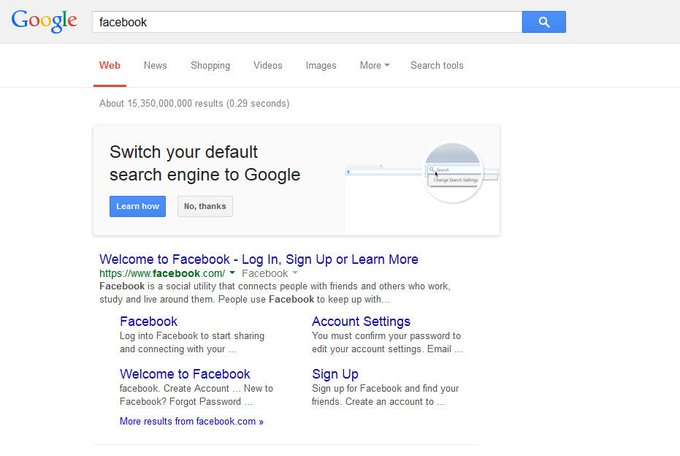
Google Is Practically Begging Firefox Users To Switch Their Default Search Engine

A new message above Google's search results is the most visible attempt yet at getting Firefox users to switch back to Google.
It almost looks desperate. Google has placed a big, new message above its organic search results that asks — practically begs — Firefox users to make Google their default search engine.
While searching tonight, I suddenly came across the giant … alert? ad? request? … that you see above. It looks a bit like a Google One box, but says “Switch your default search engine to Google” and has a button to “Learn how” and another button that says “No, thanks.”
Danny Sullivan, our founding editor, also tested this and saw the same switch request I saw. And the folks at IPIX Solutions saw it tonight, too, and tweeted about it.

 Why would Google give up the top two-plus inches of its search results page like this? It goes back to the November announcement that Mozilla was dropping Google in favor of Yahoo as the default search engine in its Firefox web browser. Even as the No. 3 browser with about 16 percent market share (according to Stat Counter), Firefox still drives a substantial number of searches.
Since the deal was announced, Yahoo’s search share rose from 8.6 percent in November (again, Stat Counter estimates) to 10.9 percent in January. According to com Score, Yahoo’s market share in the US jumped from 10.2 percent in November to 11.8 percent in December. More recently, though, there are signs that Yahoo’s market share may have hit a ceiling, at least in terms of the immediate bump from its deal with Mozilla.
The switch request showing tonight isn’t Google’s first attempt to lure back Firefox users. Wedocumented a number of other messages that have been shown to Firefox users — but none of those were placed right inside Google’s search results like this.