Showing posts with label facebook messenger. Show all posts

Wednesday, March 2, 2016

Coming in April? Facebook Messenger could spark a chatbot revolution


Facebook chess chat bot

Speculation is increasing that Facebook will open up its Messenger chat service to outside businesses, potentially as early as its F8 conference on April 12-13.
Facebook won’t comment on its plans, but such a move could open the floodgates to a revolution of sorts in computing. Chat messaging so far has been mainly between two individuals, devoid of a way to interact with companies, whether for retail or other kinds of services.
Gupshup chat
Above: Illustration of chatbot on Gupshup’s site
“April’s going to be a hot month,” said Mike Roberts, head of Messenger at Kik, the popular messaging app used by more than 8 million people in the U.S., referring to Facebook’s anticipated move to open up its 800 million users to businesses.
“It’s huge,” agreed Beerud Sheth, chief executive ofGupshup, a messaging tech company. He called chat “a once in a decade paradigm shift,” where only now is the infrastructure really ready for commerce-related transactions to happen within the chat format.
There are more than a few hints that Facebook is about to go big.
Take, for example, the quiet appearance within Messenger three weeks ago of a way to play chess with a friend within the chap app. You simply choose a friend, type “@fbchess play” into the chat box, et voila — a chessboard appears in the window. When I tried it, I was assigned white, and I followed the commands (explained in @fbchess help) to make the moves. The game was first mentioned in a conversation on Reddit.
Then another Messenger bot, @dailycute, surfaced. Again, you select your friend, and the bot delivers up photos of cute animals. This one was first cited by another Reddit user. Notably, this time there was a business associated with the bot. The image contained an URL, along with a link to the image site Imgur where the images are hosted. When I clicked on the Imgur link, I was taken to a page to download the app. See what’s going on there? Imgur can offer you an experience with Facebook’s Messenger, and presumably drive business back to its own site.
These all come after reports of a secret chatbot SDK Facebook released to help developers, an Uber experiment to offer rides through a chatbot, and the appearance of independent bots such as Assist.
Another depiction of chat process on Gupshup
Above: Another depiction of the chat process on Gupshup
These examples aren’t proof, per se, that Facebook is going to roll out bots more aggressively. They are clearly tests, and the tests offer very different experiences. Facebook may still decide to roll things out much more slowly, especially the monetization side.
But most observers believe that things will get hot very soon.
Kik has experimented for at least a year and a half with chatbots (with companies like Vans Shoes and MTV) and says it has learned some key lessons about what works and what doesn’t. Kik CEO Ted Livingston just posted on VentureBeat that these experiences are best when users can get useful services right away.
But outside factors are ratcheting up the pressure on Facebook to move, too. There’s Telegram, the mobile messaging app that has exploded in popularity,surpassing 100 million users a month after launching less than three years ago. The Berlin-based company has gained traction partly by offering strong encryption, but also partly because it opened itself up as an open platform for bots, providing an API to developers to create any bot they choose. Thousands of bots now exist, offering everything from trivia questions and dating to polling and Github updates. Telegram said it is working to release an payment API to allow businesses to make money.
In China, WeChat has led the way to make the messaging interface an operating system for people’s lives in that country, as we reported last week. Facebook is the only company with scale to do that in the West.
Telegram and WeChat are only half the story. While Telegram is opening itself up to bots, there are scores of other messaging platforms, such as Twitter, Slack, and WeChat, that businesses will also want to interact with via bots.
So another company, Silicon Valley messaging technology company Gupshup,announced last week that it would help companies actually build bots. Developers can use its new Gupshup.io engine to insert bots into a range of messaging platforms, from SMS to Slack, Teamchat, Twitter and WeChat. It does not support Facebook’s Messenger or Whatsapp, because Facebook hasn’t offered an SDK yet, the company said (correcting another report that got that wrong).
Gupshup said its messaging bots are meant to be omnichannel and embeddable into apps and websites alike.
All of this suggests that the time is ripe for Facebook to make a big move.
VentureBeat’s Mobile Summit is coming up on April 4-5, just a week before F8, and we’re devoting a portion of our event to messaging and commerce, with a working session committed to dissecting how messaging is going to open up to businesses. Kik’s Roberts will be one of the chairs of that session. The executive-level event is invite only and focused exclusively on how to grow on mobile. You can apply for admission here.

Tuesday, February 23, 2016

Facebook is using its photo-tagging technology to create incredibly detailed maps of where you live


Artificially-intelligent machine learning technologies that allow computers to “learn” to recognize patterns and make judgments have been used to translate languages, recognize objects in photos, and filter email.
Now, Facebook is using its own expertise in computer vision — the image-analysis technology that powers the social network’s photo tagging features — to create detailed maps of where people live and how factors such as population density impact their ability to connect to the Internet.
So far, the effort has yielded maps of 20 countries, particularly focusing on identifying buildings and other man-made structures in rural and remote areas.
The highly-detailed maps could also be used for other purposes, such as improving responses to natural disasters, the company said in a blog post announcing the effort on Monday.
The effort is part of Facebook’s Connectivity Labs, which oversees the technical aspects of the social network’s Internet.org effort, including its large solar-powered Aquila drones, which the company hopes to use to deliver high-speed Internet to a 50-mile area.
A team of researchers from the group worked with the company’s data science, artificial intelligence, and machine learning teams to analyze 350 terabytes worth of images that covered 21.6 million square kilometers across all the countries.
The maps could be particularly useful in determining how best to provide Internet access to people in the developing world, whether through traditional wireless or cell tower connections or more unusual means like drones, satellites, and lasers, the company says.
“The basis of this stems from being able to have accurate models of where people in the world are,” Yael Maguire, who oversees Facebook’s Connectivity Lab, told Fast Company. “The data that [already existed] was somewhat inadequate to build adequate models for where” newer technologies, such as drones and satellites could be use most efficiently.
FacebookA Facebook engineer codes at his desk.
Using computer vision techniques, the researchers were able to identify man-made structures, which they are using as a proxy for people living in a particular area.
They created the maps using a three-step process that first discarded images with large, non-man-made features, such as deserts, forests, and water, then detected whether a satellite image contained a building.
Lastly, the researchers  “trained” a neural network using a relatively small number of images — about 8,000 — to identify buildings in other countries while filtering out areas that didn’t contain man-made structures. They then redistributed census count of local populations equally over the buildings identified by the computer.
“This method assumes equal population distribution per building within a census area, which we felt was the least error-prone method of obtaining population densities since it doesn’t make any assumptions on the number of people per building and constrains systematic errors to within one census area,” wrote researchers Andreas Gros and Tobias Tiecke in the blog post.
In addition to using a relatively small number of images to train the network to recognize buildings, the effort also improves on the resolution of existing population density models. While many are currently at a resolution of 1 kilometer, Facebook’s model offers data at a resolution of 5 meters, the researchers note.
In addition to its own efforts to improve Internet connectivity, the company also plans to release its work to the public later this year, including releasing a combined population data set developed with researchers from the Center for International Earth Science Information Network at Columbia University.
Thomson ReutersFacebook CEO Mark Zuckerberg speaks on stage during a town hall with Indian Prime Minister Narendra Modi at Facebook’s headquarters in Menlo Park, California
The project has mapped Algeria, Burkina Faso, Cameroon, Egypt, Ethiopia, Ghana, India, Ivory Coast, Kenya, Madagascar, Mexico, Mozambique, Nigeria, South Africa, Sri Lanka, Tanzania, Turkey, Uganda, Ukraine, and Uzbekistan, according to Fast Company. 
The new maps join a growing number of machine learning tools developed by tech companies that have been released to the public in recent months, including Facebook’s own Torch, Google’s Tensor Flow, Microsoft’s CTNK software toolkit, and forthcoming efforts from the Open AI research collaborative funded partly by Tesla head Elon Musk.
The Facebook researchers say the mapping project could have a variety of uses in addition to improving how users in rural parts of the world go online. It could help validate census data, aid socioeconomic research, and be used to create risk assessments for natural disasters that could improve the response from agencies around the world. Making the project publicly available greatly improves the ways in which the tools can be used, one industry expert says.
“Data about human populations—whether farm output or population density—is costly and slow to obtain,” Mark Johnson, chief executive of Descartes Labs, which analyzes satellite imagery for the agriculture industry, told Fast Company. “The most exciting thing about Facebook’s work is not just about the population density of today, but looking backwards to see trends and running this analysis as new, better satellite imagery is available.”

Facebook “Birthday Cam” Encourages Videos, Not Robotic Wall Posts


Birthdays on Facebook have become a dystopian chore. Typing “HBD” or just “Happy Birthday!” on a friend’s profile is basically the least human way to interact with them. So Facebook is pushing people to record more intimate greetings with its new Birthday Cam feature launching today on iOS.
A banner on the birthday boy or girl’s profile will solicit you to capture a video message up to 15 seconds long. You can then add special birthday frames before sharing it on the friend’s wall. Oddly, the videos only appear separately rather than compiled into something more watchable. Even if you just say “happy birthday,” it’s still a lot more unique than typing it.
Facebook Birthday WallOver the years as Facebook has grown into a ubiquitous utility, it’s also developed some strange emergent behaviors. From pity liking to inviting friends to events thousands of miles from where they live, we do weird things to make our friends feel appreciated without going to much effort.
“Happy Birthday” wall posts are perhaps the most ingrained of them all. Since the early days of Facebook, it’s given you a heads-up on friends’ birthdays. That spawned the practice of posting something — anything — on their wall.
Typically it’s a generic “happy birthday,” but you always get those few actually considerate friends who at least throw in a meme, add a photo of you two, or conjure up a memory. It was always nice to skim through the posts on your cake day, and even count them and compare the number to previous years to see if your social life is up and to the right, or in need of restructuring.
Yet with time, the yearly habit lost some of its luster. The messages eventually felt repetitive and Facebook’s evolution on mobile saw upcoming birthdays moved from the web home page to the bottom of the Events tab on mobile. Perhaps the Birthday Cam can breathe some new life into one of Facebook’s oldest rituals.

Monday, February 22, 2016

Filipinos’ messaging tool of choice: Facebook Messenger


Facebook-Messenger

In Southeast Asia, Instant Messaging (IM) has emerged as the most popular messaging tool, with IM usage increasing and SMS decreasing across the board, except in the Philippines.
Filipinos still prefer to use SMS (73 percent), but those who use IM (33 percent) turn to Facebook Messenger instead of pure Over-The-Top (OTT) IM services to communicate: 94 percent of Filipino IM users use Facebook Messenger, an app that has been downloaded three times more than Skype and 10 times more than WhatsApp in this country.
Deloitte’s Global Mobile Consumer Survey 1
This is according to Deloitte’s Global Mobile Consumer Survey, which was released by Navarro Amper & Co., the local member firm of Deloitte Southeast Asia Ltd. Conducted in the third quarter of 2015, the survey covered 49,500 consumers across 31 countries to reveal some of the trending attitudes and behaviors of today’s mobile consumer. In Southeast Asia, 6,000 respondents from Indonesia, Malaysia, the Philippines (1,000 respondents), Singapore, and Thailand were polled.
The popularity of IM will continue to hold in the region, with Filipinos finding it a convenient option for chatting with friends and family overseas.
“Telecommunication operators can take advantage of this situation to increase revenues from data usage,” says Greg Navarro, Managing Partner & CEO of Navarro Amper & Co. “They can, for example, tailor chat packages to specific IM applications that are widely used in their respective local markets.”
When it comes to internet speeds, consumers in Southeast Asia are generally satisfied with their service providers but they want greater data volumes in their plans. In the Philippines, there was a drop in respondents who are satisfied with their internet speeds – from 49 percent in 2014 to 39 percent in 2015; not surprising considering the country reportedly has the second slowest internet speed in the Asia Pacific region. And only 38 percent of Filipino consumers are satisfied with their data volumes, an increase from last year’s 31.2 percent.
The survey also revealed that Internet network reliability is the top consideration for Filipinos when choosing a mobile operator, followed by price package and 4G/LTE network availability. Even consumers who are satisfied with their internet connection may change operators for either of these factors, which makes sense considering how reliant consumers are on their phones.
Deloitte’s Global Mobile Consumer Survey 2
Within 15 minutes of waking up, 79 percent of Filipino mobile phone users have already checked their phones, compared to more than half of mobile phone users in Southeast Asia. They also glance at their screens repeatedly, using their phones most frequently when commuting on public transport. It’s also worth noting that compared to other SEA countries, in the Philippines there is a significant proportion of users – 31 percent – who listen to online radio via their smartphones.
Respondents were also asked how they connect to the internet based on their location. Eighty-two percent of Filipino respondents said they use Wi-Fi at home, in the workplace, or their place of study; only 25 percent of Filipino respondents use Wi-Fi in public places.
“Again, there’s an opportunity here for telecom operators to monetize Wi-Fi for consumers on public transport facilities,” says Navarro. “And with the government’s project to provide free Wi-Fi in underserved areas of the country, it will be interesting to see how these statistics and behaviors change over the next few years.”Deloitte’s Global Mobile Consumer Survey 3
Another capability worth exploring for telcos is mobile payment. Across the Southeast Asian countries polled, majority of respondents are willing to use mobile-based, in-store payment solutions – in the Philippines, 62 percent of respondents are willing to give it a try – but these respondents say there is a lack of availability of such solutions, and when it is available, it entails slower processing times compared to cash or credit card transactions.
“Telecom operators that want to take advantage of this functionality need to offer solutions that enable simple and quick transactions. They also need to improve payment security, so that consumers can be comfortable using mobile payments even for big ticket transactions, and expand the number of point-of-sale terminals that accept mobile payments,” says Navarro.

Friday, February 19, 2016

Facebook Plans To Put Ads In Messenger


A leaked document Facebook sent to some of its biggest advertisers reveals that Facebook will launch ads within Messenger in Q2 2016.
The document, obtained by TechCrunch but kept private to protect its verified source, says businesses will be able to send ads as messages to people who previously initiated a chat thread with that company. To prepare, the document recommends that businesses get consumers to start message threads with them now so they’ll be able to send them ads when the feature launches.
The document also notes that Facebook has quietly launched a URL short link fb.com/msg/ that instantly opens a chat thread with a business. Facebook confirmed the existence of the URL short link. That seems to back up the validity of the leaked document.
Facebook Business Messages
An example of messages between businesses and users
Regarding Messenger ads specifically, Facebook told me “We don’t comment on rumor or speculation. That said, our aim with Messenger is to create a high quality, engaging experience for 800 million people around the world, and that includes ensuring people do not experience unwanted messages of any type.” That last part sounds like Facebook trying to reassure users that even when there are ads, they won’t be completely unsolicited, and it’s going to be very careful.
Messenger is one of Facebook’s most popular and fastest-growing products, with 800 million monthly active users. Yet the social network has never monetized it directly before.
Thankfully for users, Facebook isn’t going to let brands send ad messages to just anyone or even people who’ve liked their Pages. Only those who have voluntarily chatted with a business can be sent ads. This should somewhat limit the spam potential and annoyance. Right now, almost all messages come from one’s friends, so Facebook will likely try to preserve this high signal-to-noise ratio with limits on advertising.
The news somewhat contradicts what Mark Zuckerberg said to calm users of WhatsApp when Facebook acquired it in early 2014. “I don’t personally think ads are the right way to monetize messaging,” Zuckerberg said on an analyst call. WhatsApp’s CEO Jan Koum went further in a 2012 blog post, stating that “Advertising isn’t just the disruption of aesthetics, the insults to your intelligence and the interruption of your train of thought,” but also a waste of engineering resources.
Yet as more content from friends, news publishers, video makers and brands compete for limited space in people’s News Feeds, Facebook has apparently grown willing to let advertisers pay to ping people directly. It’s not the only one opening new direct channels between the two. Twitter today announced new ways for companies to offer customer service through DMs.

Replacing The 1-800 Number

davidmarcushorizontal
Facebook’s Head Of Messenger David Marcus
Facebook has been slowly enhancing the ways businesses can privately communicate with people since late 2011. That’s when it first began letting users send messages to Pages, which were only then allowed to message them back. Originally, this was designed to let businesses move messy or irate customer service conversations off their Wall where other fans could see.
Facebook redoubled its business chat efforts when it hired PayPal President David Marcus to run Messenger in 2014. He came with a vision that Facebook could do a better job of letting companies talk with customers than phones and 1-800 numbers with clumsy touch-tone menus and hold times.
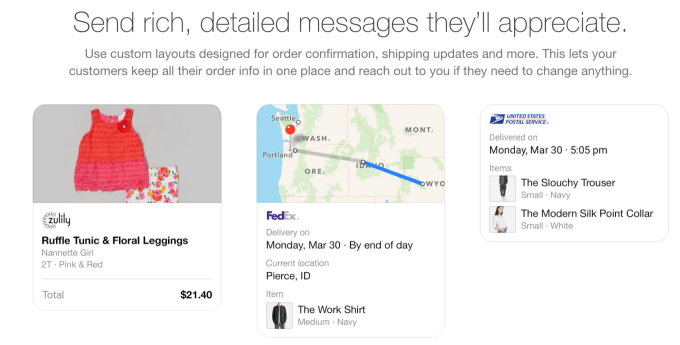
At its F8 conference in March 2015, Facebook announced its Businesses On Messengerprogram that let e-commerce customers get receipts and chat with customer service reps to change orders. It also allowed businesses to integrate with third-party tools like Zendesk and Conversocial to manage their incoming messages.
screen-shot-2015-03-25-at-10-53-11-am
Over the following months, Facebook enhanced chat capabilities for businesses by letting them show a big “Send Message” or “Contact Us” button on their Page, create saved replies, show a badge that grades them on how fast they respond, and reply to wall posts with private messages.
Facebook also recently introduced “Click To Message” News Feed ads that let businesses pay to get people to chat with them. Plus, it’s been secretly testing a chat bot platform that allows developers to create e-commerce experiences and personal assistants within Messenger.

Facebook’s Most Forceful Ad Yet

Now Facebook is pushing brands to use these tools to encourage people to message them so they’ll eventually be able to send ads in return. According to the leaked document, it’s also recently released a new tool: the Messenger URL short link. It’s now live for all Pages, through the format fb.com/msg/ and then the Facebook Username of the Page, likefb.com/msg/techcrunch.
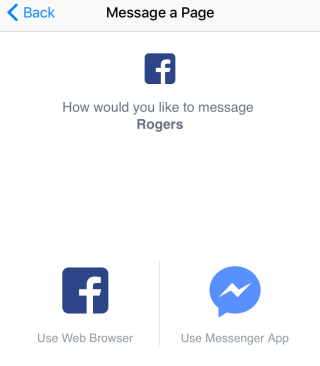
Facebook Messenger URL Short LinkBrands can share and promote their link. When tapped by a user, it will start a conversation with the brand either in the Messenger app, or on Facebook’s mobile web or desktop site. Facebook confirmed to me that a few partners include Canadian telecom Rogers are already trying out the fb.com/msg/Rogers shortcode, but Facebook didn’t talk about it.
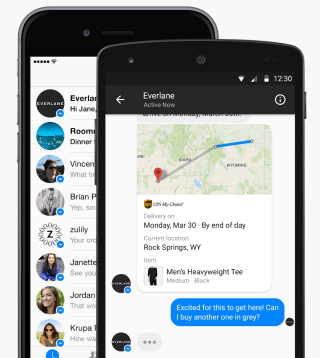
This short link is essentially the next-generation version of a 1-800 number. Instead of calling 1-800-FLOWERS, you’d be able to just click something like fb.com/msg/flowers and chat at your own pace with a customer service agent. No “Press 1 to hear a list of options.” No “Please hold.”
If businesses achieve a 90 percent response rate to messages within 24 hours over the past week, their Messenger handle will become searchable on Facebook, the document details. This could further stoke in-bound message threads that will eventually become opportunities to show ads.
It’s unclear exactly what businesses will be able to put in Messenger ads, but there are plenty of possibilities. The document says the ads are supposed to carry on the existing discussion users started. The ads could perhaps:
  • Inform customers about a flash sale, free gift or other promotion
  • Announce a product launch, and encourage foot traffic or provide a link to buy the item online
  • Deliver a new video, GIF or other piece of content created by the brand
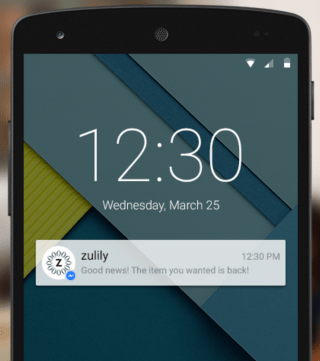
  • Follow up with retargeting-style reminders that an item the user previously considered buying is no longer out of stock or has dropped in price
Facebook Business Message ThreadsConsidering this is the most direct and forceful way for businesses to advertise to or interact with potential customers, Facebook could likely charge steep rates.
There’s always a chance that early tests to Messenger ads receive negative feedback and the plan gets scuttled. The last thing Facebook wants to do is cram spam into Messenger and give people a reason to return to SMS or another chat platform. Expect these ads to be slowly and thoroughly tested before possibly being rolled out.
Right now pretty much every time Messenger buzzes, you know it’s one of your friends and is probably worth looking at. Facebook will have to aggressively thwart spam or misuse of Messenger ads to make money while keeping its chat app at the center of our mobile lives.

Friday, February 12, 2016

Facebook is testing SMS, multiple accounts in Messenger

It looks like the features are Android-only, at least for now.


Facebook has slowly beefed up its Messenger offering over the past year, with not only the ability to send payments and hail an Uber ride, but also the addition of an AI-inspired personal assistant (or at least the promise of). Now it looks like Messenger will have a couple of other features added in the near future: the integration of SMS plus support for multiple accounts. It was first seen on Android Police but we've since received confirmation from Facebook that the company is indeed testing these new features.
"At Messenger we are always trying to create new ways for people to communicate seamlessly with everyone," said a Facebook spokesperson. "Right now, we're testing the ability for people to easily bring all their conversations -- from SMS and Messenger -- to one place. It's a really simple way to get, see and respond to all your SMS messages in just one app. By choosing to access your SMS messages in Messenger, they're right alongside all the other enhanced features that Messenger offers."
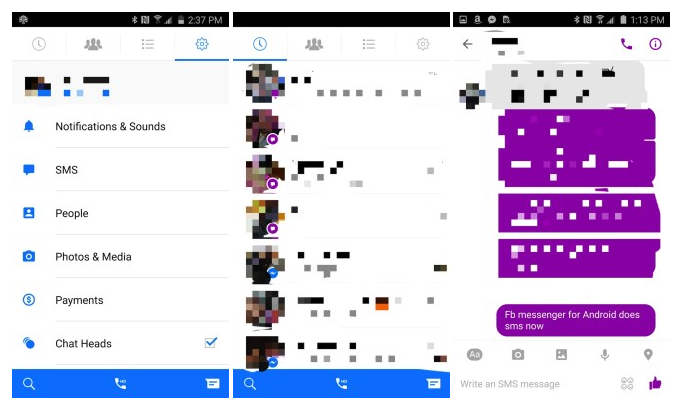
We should note here that SMS was actually a part of Facebook Messenger before, but it was removed a few years ago due to low adoption. But perhaps with the advent of messaging apps like WhatsApp and Google's Hangouts, Facebook had a change of heart. From the Android Policescreenshots, it looks like the SMS messages will be colored differently -- purple instead of blue -- and that it's an optional feature that can be enabled or disabled in settings.

Screenshot credit: Android Police
As for multiple accounts on Messenger, Facebook had this to say: "Millions of people share phones with their family and friends. Until now, there hasn't been an easy way for people to access their individual Messenger accounts from shared devices. To address this, we've launched a feature on Android to enable multiple people to log in and use Messenger from a single phone."
We're not quite sure why family and friends would want to share Messenger accounts on a single phone, but we can see this feature being more useful in a tablet, where it's more likely to be a shared household device. It could also be useful if you have both a personal and a professional account. From the looks of it, you can add accounts to the Messenger app in settings and be able to switch between them as you wish. There's no telling when these features will arrive for all Android phones, but we wouldn't be surprised if they appeared on your device in the near future.

Saturday, October 31, 2015

Facebook Messenger gets Message Requests to let you talk with anyone

Facebook Messenger gets Message Requests to let you talk with anyone

Facebook (FB) is getting rid of its “Other” folder for messages in favor of a new feature.
All messages sent from people on a user’s friends list will come to their normal inbox.
Facebook says that it wants Messenger to be the place where users can connect with anyone they need to reach just by knowing their name.
“Now, the only thing you need to talk to virtually anyone in the world, is their name”, enthused Messenger boss David Marcus.
“We’ve heard so many stories like estranged parents trying to get back in touch, or you lost your wallet and someone trying to get in touch with you” Messenger’s Product Manager on Message Requests Tony Leach explained to TechCrunch.
The new function, referred to as “Message Requests“, permits individuals to attach with anybody by way of chat. And so will we, once the Other Inbox will be replaced by the Message Requests feature worldwide.
Message requests are starting to roll out to all Facebook users today.
‘While this may seem like a small change, it’s actually a foundational development, ‘ continued Mr Marcus.
Similar to Friend Requests, you will be able to accept messages from the sender, or ignore them if you suspect they are spam. Basically this feature will notify you when you have a message from someone you don’t know, as you can see in the screenshot above. The Message Request feature will now take any message from someone you’re not friends with, so long as they don’t have your phone number, and tuck it inside a notification box at the top of your Messenger queue.
Until now, Facebook’s messaging system has had a niggling flaw: when somebody not directly connected to you reached out, there was a strong chance it would be sent to the “Other Messages” folder. There is also an important point about privacy here, since users can now block a person by name to ensure that they stay blocked.
The move is part of Facebook’s strategy to become stronger in mobile communication.

Friday, May 29, 2015

New Chrome extension can pinpoint your Facebook Messenger locations


Stalkers are likely in for a treat as a new app is going to help them creep up on their Facebook friends. As if Google wasn’t enough. A new Google Chrome extension called Marauders Map, inspired by the map in the Harry Potter franchise, will allow users to see exactly from where their contacts are messaging them, without their permission or consent.

Created by a student developer in Cambridge, Massachusetts, Aran Khanna, the extension will grab a user’s location data from Facebook Messenger and will quickly plot it out on a map. The location is said to be extremely precise and makes it super easy to stalk a person’s vicinity. To make things more easy, it can fetch location data from the past as well as long as location sharing was enabled, which is mostly on by default on iOS and Android apps.


Aran Khanna mentioned in a blog post on Medium, “Everyone I have shown this extension to has been anywhere from surprised to appalled that this much of their very personal data is online for their friends (and even complete strangers) to access.” A report by Engadget points out that this is not real-time tracking method by any means. The extension simply compiles the embedded data into a cohesive map.

If users find the whole idea of being stalked on Facebook Messenger too creepy for their taste, they can opt out from the feature by turning off the GPS location service and disable it in their smartphone’s settings as well.

Game development 

The employees at Pixotri Game Studio have vast experience in creating games and are always trying to push the boundaries of technology and creativity. The games are created using the most popular game enigine Unity, which provides robust, high performance, platform independent solution to creating games.

Pixotri technology is a  creative house developing quality web designs, E-Commerce solution. SEO services and Gaming development .
Contact us for your mobile gaming requirements email- info@pixotritechnologies.com. Visit our website: www.pixotritechnologies.com

Thursday, May 21, 2015

Facebook Messenger Expands Free Video Calling Worldwide

Last month, Facebook launched a free video calling feature in its Messenger app so you can set up face-to-face conversations with your family and friends with just one tap. Facebook Messenger’s video calling feature started in 18 countries, including Belgium, Canada, Croatia, Denmark, France, Greece, Ireland, Laos, Lithuania, Mexico, Nigeria, Norway, Oman, Poland, Portugal, the U.K., the U.S. and Uruguay. Facebook Messenger’s free video calling feature has now rolled out worldwide, according to Facebook’s Vice President of Messaging Products David Marcus.

Marcus pointed out that there are a few countries that do not have access to the free video calling service due to quality issues, especially since the feature does not require a WiFi connection. Marcus said that he “would love to offer the service in UAE, but operators are blocking it.”

You will need to have the latest version of the Facebook Messenger iOS or Android app downloaded for access to the video calling feature. And the callers on both ends need to have the Facebook Messenger app. By adding a video calling feature globally to Facebook Messenger, Facebook now strongly competes against Apple's AAPL +0.03% FaceTime, Microsoft's MSFT +0.04% Skype and Google's GOOGL +0.65% Hangouts.

To use the video calling service on Facebook, click on the video icon at the top right corner of the screen. This lets you start a video call from within an existing Messenger conversation. Once you start the video call, the camera starts in selfie mode and you will be able to switch to the rear camera. During a video call on Facebook Messenger, a small window shows what your camera is pointing at — which you can drag around. You can also cut the video feed on your end and play just the audio of the conversation.


Facebook currently has over 600 million monthly active users and there are plans to make it a broader platform. Facebook Messenger lets users send payments to each other. Facebook also launched a standalone website for Facebook Messenger called Messenger.com. And Facebook is reportedly in talks with third party developers to build apps and games for Facebook Messenger. Some of the launch partners Facebook partnered with to build Messenger-related apps include ESPN, The Weather Channel and JibJab.

WEB DESIGN

We are a professional web design company with an experienced  team of creative professionals.  We create outstanding designs for  Websites. Our team is adept at implementing the latest web standards and programming techniques.Pixotri technology is a  creative house developing quality web designs, E-Commerce solution. SEO services and Gaming development .

Contact us for your web design requirements email-info@pixotritechnologies.com Visit our website: www.pixotritechnologies.com